

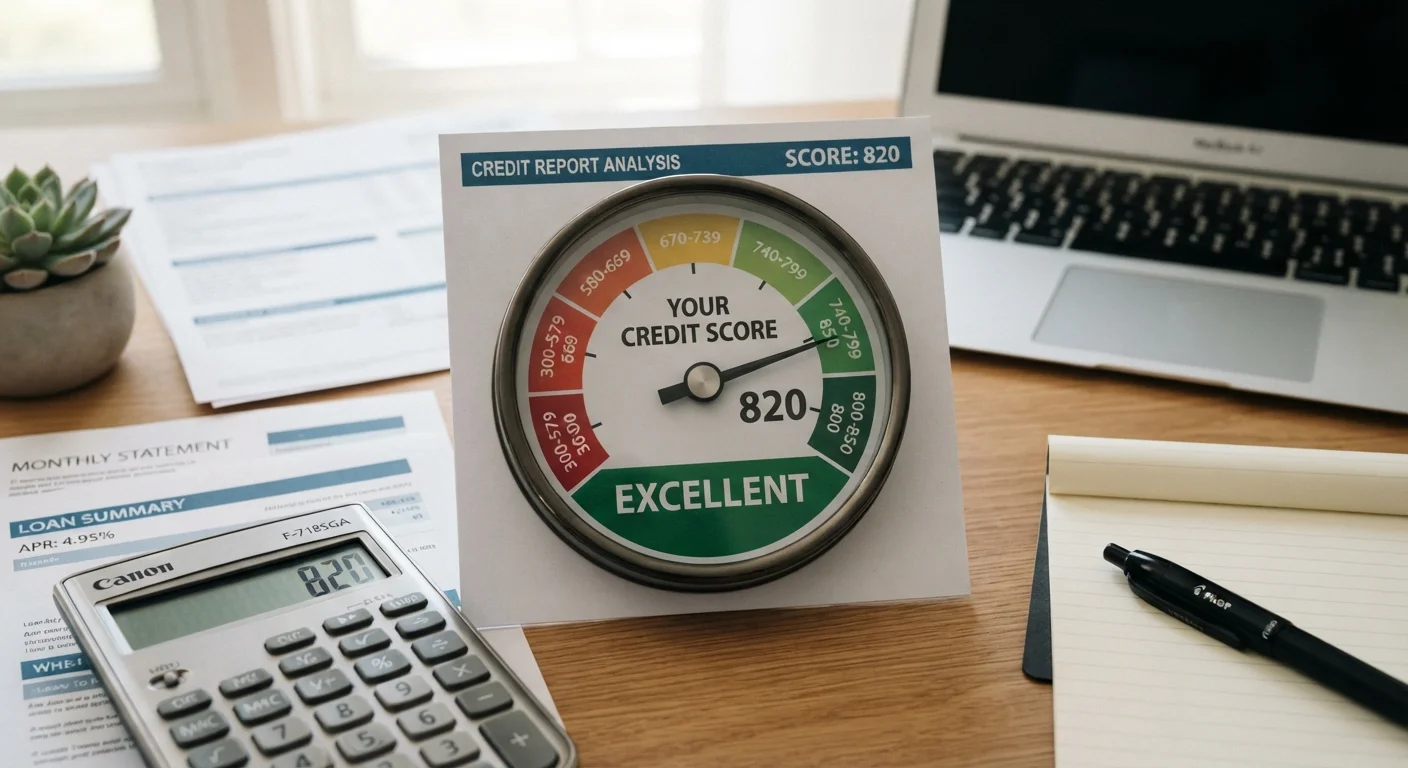
Why credit score myths spread
Credit scoring is a system most people interact with indirectly: through a loan approval, a rental application, or an interest rate offer. Because the underlying calculations are proprietary and the results feel high-stakes, misconceptions fill the gap. Some myths started as outdated rules of thumb. Others stem from partial truths that got simplified into bad advice.
The cost of acting on bad information is real. A misplaced belief about what helps or hurts your score can lead someone to close a useful account, avoid checking their own report, or skip comparison shopping on a major loan. This article addresses six of the most persistent myths with accurate, sourced corrections.
This article is for general informational purposes only and is not personalized financial or legal advice. Consult a licensed financial adviser or credit counselor for guidance specific to your situation.
The six myths, corrected
Myth
Checking your own credit score will lower it.
Fact
Checking your own score is a soft inquiry and has no effect on your credit score whatsoever.
Credit inquiries fall into two categories: soft and hard. A soft inquiry happens when you check your own score, when a lender pre-approves you without your application, or when an employer runs a background check. Soft inquiries do not appear on the version of your report that lenders see, and they do not change your score.
A hard inquiry occurs when you formally apply for credit, such as a new card, auto loan, or mortgage. Each hard inquiry can temporarily lower your score by a few points. Checking your own report through a credit bureau or a financial app is always a soft pull. The Consumer Financial Protection Bureau (CFPB) recommends reviewing your credit reports regularly as part of sound financial management.
Myth
Closing an old credit card you no longer use will improve your score.
Fact
Closing a card typically lowers your score by reducing available credit and shortening your average account age.
Your credit utilization ratio, how much of your available revolving credit you are currently using, accounts for roughly 30 percent of a FICO score. When you close a card, you lose that card's credit limit. If you carry balances on other cards, your utilization ratio rises immediately, which can lower your score.
Account age also matters. Credit scoring models consider both the age of your oldest account and the average age across all accounts. Closing an older card pulls that average down. There may be good reasons to close a card, such as a high annual fee with no benefit, but the decision should factor in these scoring effects. For a plain-language explanation of how utilization and other terms work, see the personal finance vocabulary guide.
Myth
Carrying a small balance on your credit card each month builds credit faster.
Fact
Paying your statement balance in full each month is sufficient to build credit and avoids interest charges.
This myth likely persists because people confuse activity with indebtedness. What credit scoring models register is that you used credit (the account reports a balance to the bureau) and paid on time. A zero balance after a full payment still shows account activity and an on-time payment history, which is the single largest factor in a FICO score at approximately 35 percent.
Carrying a balance into the next billing cycle generates interest charges without any scoring benefit. There is no requirement to pay interest to earn a higher score.
Myth
Your income directly affects your credit score.
Fact
Income is not a factor in any major credit scoring model; scores are based entirely on credit behavior.
FICO and VantageScore calculate scores using data found on your credit report: payment history, amounts owed, length of credit history, new credit inquiries, and credit mix. Income does not appear on a standard credit report and is therefore not part of the calculation.
Lenders may ask for your income when you apply for credit to assess your ability to repay, but that assessment is separate from your credit score. A person with a modest income and a consistent payment history can hold a higher score than someone with a large income who pays late or carries high balances.
Myth
Shopping around for a mortgage or auto loan will heavily damage your score with multiple hard inquiries.
Fact
Credit scoring models group mortgage and auto loan inquiries made within a short window, typically 14 to 45 days, and count them as a single inquiry.
This grouping is intentional. Scoring models recognize that consumers comparison-shopping for a home loan or car loan are making one borrowing decision, not opening multiple lines of credit. FICO's older models use a 14-day window; newer versions extend that to 45 days. VantageScore uses a 14-day window.
The same logic does not apply to credit card applications, which are each counted separately. For consumers weighing a home purchase and wondering how rate shopping interacts with their overall financial picture, the fixed-rate vs. adjustable-rate mortgage comparison explains how loan structures differ.
Myth
Negative marks on your credit report are permanent.
Fact
Most negative items fall off your credit report after seven years; Chapter 7 bankruptcy stays for ten years.
Under the Fair Credit Reporting Act (FCRA), consumer reporting agencies must remove most adverse information after seven years from the date of the original delinquency. This covers late payments, collections, charge-offs, and foreclosures. Chapter 7 bankruptcy is the main exception, remaining for ten years.
This means a missed payment from several years ago has diminishing impact over time and will eventually disappear from your report entirely. Keeping accounts current from this point forward progressively improves the picture lenders see.

Separating these myths from accurate information matters especially when applying for a mortgage or auto loan. For a broader look at how misleading financial assumptions affect consumers, the pattern extends to insurance as well: see common health insurance myths for a comparable breakdown in that category.
What actually moves your score
35%
Payment history share of a FICO score
According to FICO's published scoring criteria, on-time payment history is the single largest component of a standard FICO score.
7 years
How long most negative items remain on a credit report
The Fair Credit Reporting Act sets a seven-year limit for most adverse credit entries, such as late payments and collections.
30%
Credit utilization share of a FICO score
FICO's published model weights amounts owed, including utilization ratio, at approximately 30 percent of the total score.
The five factors in a standard FICO score are payment history, amounts owed (which includes utilization), length of credit history, new credit, and credit mix. Payment history and utilization together account for roughly 65 percent of the calculation. The practical implication: paying on time and keeping balances low relative to credit limits will do more for a score than any workaround strategy.
Consumers who want to work on their credit profiles systematically often benefit from understanding the full vocabulary involved. The personal finance vocabulary guide covers terms like APR, amortization, and credit utilization in plain language.
Your free annual credit reports
Under federal law, you are entitled to a free credit report from each of the three major bureaus (Equifax, Experian, and TransUnion) through AnnualCreditReport.com. Reviewing these reports regularly lets you catch errors or fraudulent accounts early. Disputing inaccurate information is a right protected under the Fair Credit Reporting Act.
The content provided on our blog site traverses numerous categories, offering readers valuable and practical information. Readers can use the editorial team’s research and data to gain more insights into their topics of interest. However, they are requested not to treat the articles as conclusive. The website team cannot be held responsible for differences in data or inaccuracies found across other platforms. Please also note that the site might also miss out on various schemes and offers available that the readers may find more beneficial than the ones we cover.