

Our Verdict
Fixed-rate mortgages give borrowers a predictable payment for the full loan term, which can simplify long-term budgeting. ARMs may cost less in the early years, but they carry the risk of higher payments if rates rise after the adjustment period. Neither structure is inherently better; the lower-cost choice depends on how long you hold the loan and where interest rates move.
| Best for | Recommended |
|---|---|
| Borrowers planning to stay in the home for many years | Fixed-rate mortgage |
| Borrowers who expect to sell or refinance within the initial fixed period | Adjustable-rate mortgage |
| Those who prioritize payment stability over potential savings | Fixed-rate mortgage |
| Those comfortable with some payment uncertainty in exchange for a lower starting rate | Adjustable-rate mortgage |
How the two rate structures work
A fixed-rate mortgage locks in one interest rate at closing. That rate applies to every payment for the entire loan term, whether the loan runs 15 or 30 years. Your principal-and-interest payment stays the same even if market rates double or drop to zero.
An adjustable-rate mortgage (ARM) starts with a fixed rate for a set number of years, then resets periodically based on a market index. A 5/1 ARM, for example, holds its initial rate for five years, then adjusts once per year. A 7/6 ARM fixes the rate for seven years, then adjusts every six months. The new rate after each adjustment is calculated by adding a margin set by the lender to the current value of a reference index, commonly the Secured Overnight Financing Rate (SOFR).
If you are not familiar with terms like amortization or APR, the personal finance vocabulary guide covers those definitions in plain language before you compare loan offers.
What the numbers look like in practice
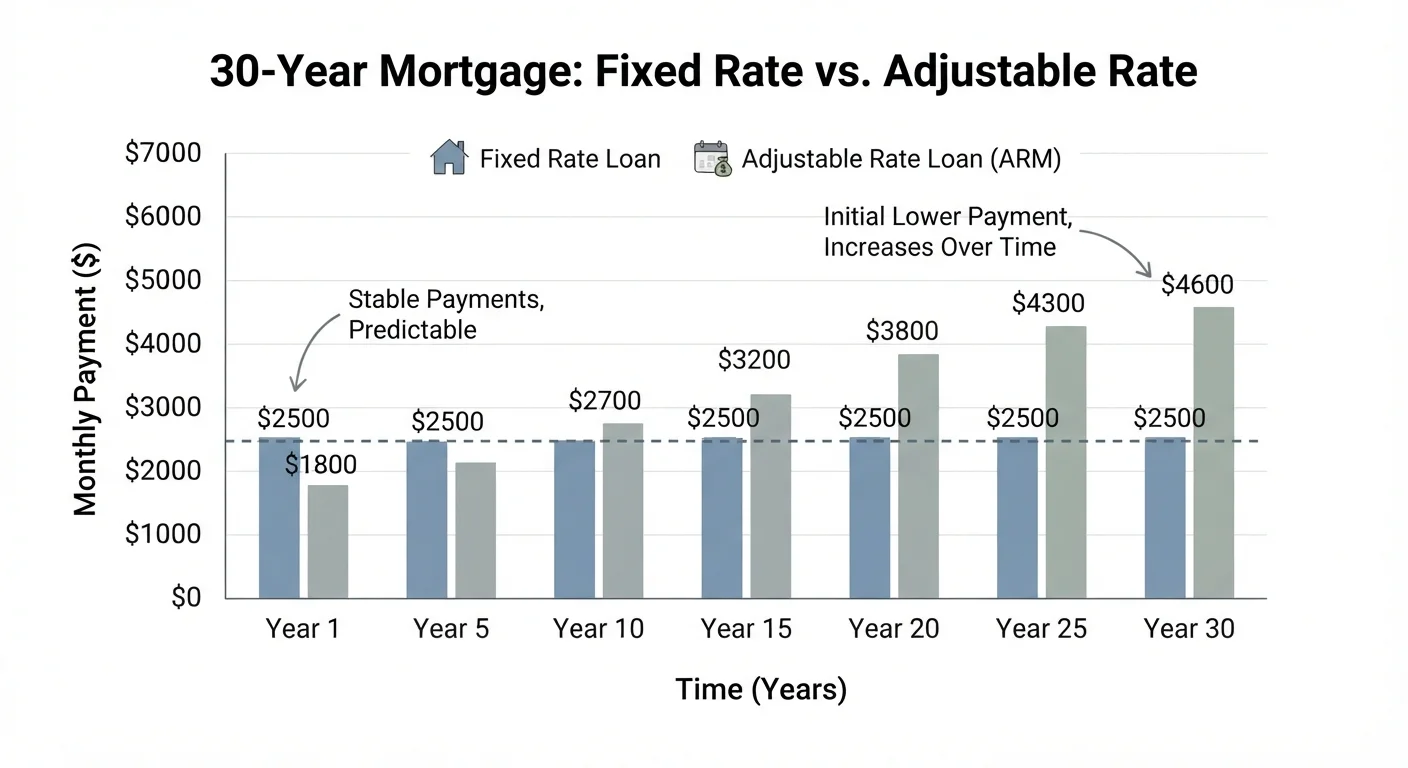
Assume a $350,000 loan. If a 30-year fixed rate is 7.0%, the monthly principal-and-interest payment is approximately $2,329 and stays there for 360 payments. If a 5/1 ARM opens at 6.0%, the payment for the first five years is roughly $2,098 per month, a difference of about $231 per month, or $13,860 over the initial period.
After year five, the ARM adjusts. If the index has risen enough to push the rate to 8.0%, the new payment climbs to approximately $2,468 per month, higher than the fixed-rate alternative. Caps limit how much the rate can move at each adjustment and over the life of the loan. A common cap structure is 2/2/5, meaning the rate can rise no more than 2 percentage points at the first adjustment, 2 points at any subsequent adjustment, and 5 points above the starting rate in total. Even with caps, a borrower who stays in the home long enough may pay substantially more than they would have under a fixed structure.
| Feature | Fixed-rate mortgage | Adjustable-rate mortgage | |
|---|---|---|---|
| Interest rate over time | Fixed-rate mortgage | Unchanged for full term | Changes after initial period |
| Initial rate level | Fixed-rate mortgage | Typically higher | Typically lower |
| Payment predictability | Fixed-rate mortgage | High | Lower after first adjustment |
| Rate caps | Fixed-rate mortgage | Not applicable | Yes, periodic and lifetime caps apply |
| Best time horizon | Fixed-rate mortgage | Long-term ownership | Short- to medium-term ownership |
| Refinancing need | Fixed-rate mortgage | Less often necessary | May be needed if rates rise sharply |
When each structure tends to cost less
The fixed-rate loan costs less in total interest when you hold it for many years and when market rates rise above your locked rate. The ARM costs less when you sell or refinance before the initial fixed period ends, or when market rates stay flat or fall after the adjustment begins.
A rough break-even calculation compares the monthly savings during the ARM's fixed period against the potential extra cost if rates rise after it ends. That calculation requires assumptions about future rate movements, which no one can predict reliably. Treating any projection of future ARM payments as certain would overstate your confidence in the outcome.
Borrowers who have considered how rate structure affects their overall financial picture may also find it useful to review common credit score misconceptions, since your credit profile affects the rates lenders offer on both loan types.
Questions worth asking before you choose
Before committing to either structure, consider these practical questions:
- How long do you realistically expect to own this home?
- If the ARM rate reaches its cap, can your budget absorb that payment?
- Does the lender's ARM include a conversion option that lets you switch to a fixed rate later?
- What index does the ARM use, and how volatile has that index been historically?
- How does the total interest paid compare across both options at your expected time horizon?
Get loan estimates in writing
Federal law requires lenders to provide a standardized Loan Estimate within three business days of receiving your application. That document shows the interest rate, projected monthly payment, and total closing costs for the specific loan you applied for. Comparing Loan Estimates side by side across lenders is one of the most direct ways to see how the numbers differ before you commit.
This article is general financial education and is not personalized advice. Mortgage terms, eligibility, and costs vary by lender, loan program, and individual financial profile. Consult a licensed mortgage professional or financial adviser before making a borrowing decision.
The content provided on our blog site traverses numerous categories, offering readers valuable and practical information. Readers can use the editorial team’s research and data to gain more insights into their topics of interest. However, they are requested not to treat the articles as conclusive. The website team cannot be held responsible for differences in data or inaccuracies found across other platforms. Please also note that the site might also miss out on various schemes and offers available that the readers may find more beneficial than the ones we cover.