


Why a systematic approach matters
Carrying multiple debts at once, credit cards, auto loans, medical bills, can make it hard to know where to direct any extra money. Without a clear order of operations, payments tend to scatter, and interest compounds on balances that could have been reduced months earlier.
A systematic approach does two things: it reduces the total cost of your debt over time, and it gives you a framework so each payment decision is already made. Before choosing a method, make sure you understand the terms attached to each balance. The personal finance vocabulary guide covers terms like APR and amortization in plain language if any of those concepts feel unfamiliar.
This article is for general informational purposes only and is not personalized financial advice. Consult a licensed financial professional for guidance specific to your situation.
The avalanche method
The avalanche method directs any money beyond your minimum payments toward the debt with the highest annual percentage rate (APR). Once that balance reaches zero, you redirect that payment to the next highest-rate debt, and so on.
Mathematically, this approach costs less in total interest over the life of your debts. If you carry a credit card at 24% APR alongside a personal loan at 11%, every extra dollar applied to the credit card stops accruing at the higher rate sooner.
The drawback is patience. If your highest-rate debt also carries a large balance, it may take months before you see a balance hit zero. Some people find that discouraging and abandon the plan. The avalanche works best for people who are motivated by knowing they are minimizing costs, even when early progress is slow.
The snowball method
The snowball method directs extra payments toward the debt with the smallest balance first, regardless of interest rate. Each paid-off account frees up its minimum payment, which then rolls into the next smallest balance.
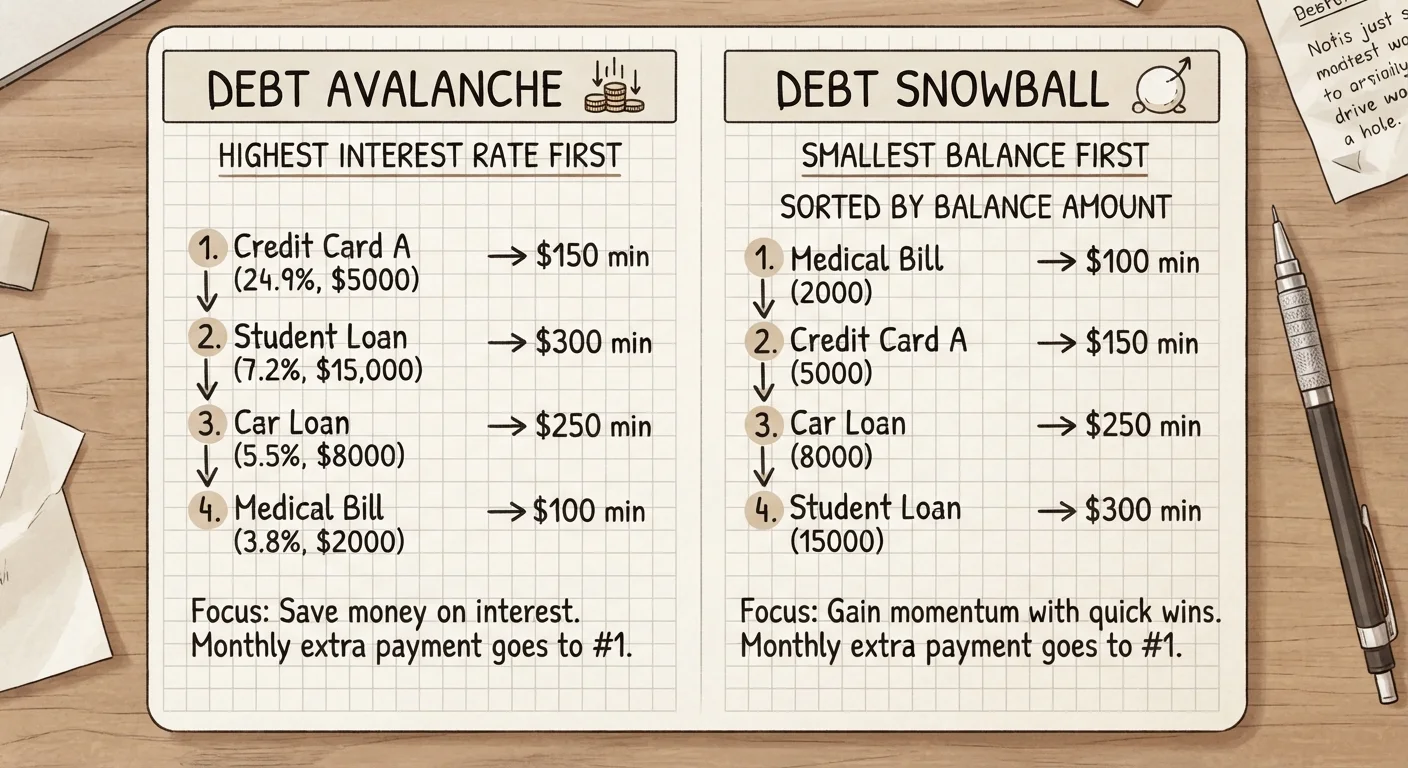
The appeal is psychological. Eliminating a balance entirely, even a small one, provides a concrete milestone. That sense of progress can sustain motivation through a long payoff timeline. Research in behavioral economics has found that some people are more likely to stay on track when they experience early wins, though individual responses vary.
The trade-off: if your smallest balance carries a low rate while a larger high-rate balance grows, you will pay more in total interest than you would with the avalanche sequence. Whether that cost is worth the motivational benefit depends on your own patterns with money.
List every debt before choosing a payoff strategy
Without a complete picture of balances, rates, and minimums, you cannot accurately compare methods or identify which debt costs the most. Missing even one account can skew your plan.
Always pay every minimum on time, every month
Late payments generate fees, can trigger penalty APR rates, and damage your credit report. Focusing extra payments on one debt while missing minimums elsewhere creates new costs that offset your progress.
Direct any windfall money toward your target debt
Tax refunds, bonuses, or other unexpected income can meaningfully shorten a payoff timeline when applied directly to your priority balance rather than absorbed into general spending.
Reassess your plan after each debt is paid off
As balances change and interest rates shift, the optimal next target may differ from your original list. A periodic review keeps the strategy current with your actual situation.
Avoid taking on new high-interest debt while paying down existing balances
Adding new debt at high rates can cancel out the progress from extra payments, extending your payoff timeline and increasing total interest paid.
Building a foundation before you choose a method
Neither method works without a budget that identifies how much money is available each month after essential expenses. Several budgeting frameworks can help you find that number, from zero-based budgeting to the 50/30/20 approach.
A few steps apply regardless of which payoff sequence you choose. First, list every debt with its balance, minimum payment, and APR. Second, confirm you are making every minimum payment on time. Late payments trigger fees and can raise your rate through penalty APR clauses. Third, identify any debt with a promotional 0% rate and its expiration date, since that balance may need its own priority before the rate resets.
If your debt load feels unmanageable, nonprofit credit counseling agencies (accredited through the National Foundation for Credit Counseling) can review your full picture and suggest options including debt management plans. These services are typically low-cost or free.
The content provided on our blog site traverses numerous categories, offering readers valuable and practical information. Readers can use the editorial team’s research and data to gain more insights into their topics of interest. However, they are requested not to treat the articles as conclusive. The website team cannot be held responsible for differences in data or inaccuracies found across other platforms. Please also note that the site might also miss out on various schemes and offers available that the readers may find more beneficial than the ones we cover.