

Our Verdict
Each budgeting method addresses a different spending challenge. Zero-based budgeting suits detail-oriented people who want full control; the 50/30/20 rule suits those who want simplicity. Envelope and pay-yourself-first approaches work best when one specific behavior, overspending or under-saving, is the core problem to solve.
| Best for | Recommended |
|---|---|
| People who want full visibility into every dollar spent | Zero-based budgeting |
| Those with stable income who prefer a low-maintenance framework | 50/30/20 rule |
| People who consistently overspend in specific categories | Envelope budgeting |
| Those whose primary goal is building savings consistently | Pay-yourself-first budgeting |
What budgeting methods are and why the differences matter
A budgeting method is a framework for deciding, in advance, where your money goes each month. The mechanics vary widely: some require tracking every transaction; others ask only that you move money into the right account at the start of the month. Because income types, family sizes, and financial goals differ, a method that works well for one household can feel unworkable in another.
The four methods covered here are zero-based budgeting, the 50/30/20 rule, envelope budgeting, and pay-yourself-first budgeting. Each has a distinct logic, and the comparison below is meant to help you identify which logic matches your situation. This article is general financial education and is not personalized financial advice. For guidance on your specific circumstances, consult a licensed financial professional.
Zero-based budgeting
Zero-based budgeting assigns every dollar of income a specific purpose so that income minus expenses equals zero at the end of the month. The goal is not to spend everything; savings and debt payments count as assignments. A person earning $4,000 a month would map out categories, rent, groceries, utilities, savings, and so on, until the full $4,000 is allocated.
This method gives a complete picture of where money is going, which makes it useful for people trying to cut spending or pay down debt systematically. The tradeoff is time: it requires either a monthly planning session or consistent transaction tracking throughout the month. Variable income makes it harder to apply, because the starting figure changes each month.
The 50/30/20 rule
The 50/30/20 rule divides after-tax income into three broad categories: 50% toward needs (housing, utilities, groceries), 30% toward wants (dining, entertainment, travel), and 20% toward savings and debt repayment. The proportions are guidelines, not strict limits.
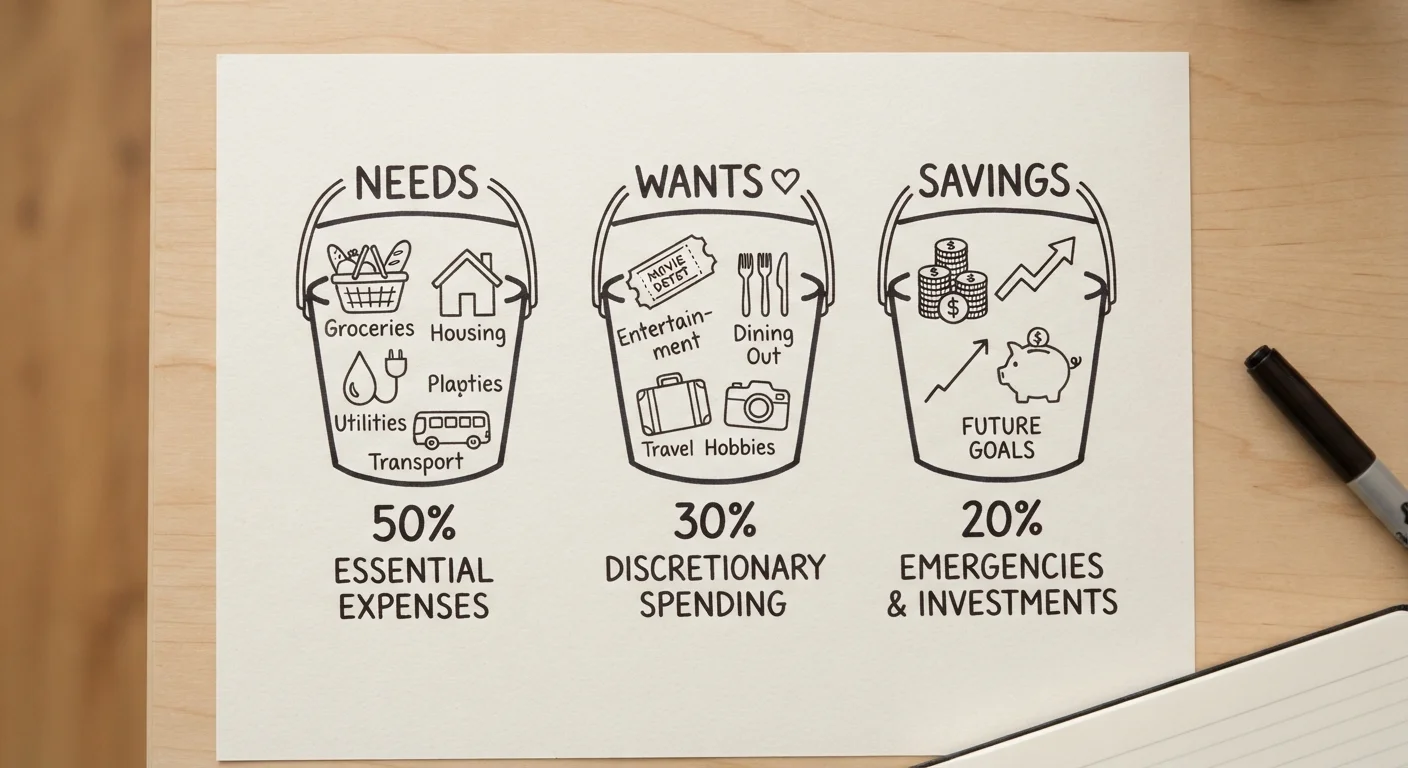
The appeal is simplicity. Someone who does not want to categorize every purchase can check at the end of the month whether spending stayed roughly within those bands. The method works best when income is stable and predictable. If you are retired and working from a fixed income, see our retirement budget planning framework for a closer look at aligning fixed income streams to monthly expenses.
| Zero-based | 50/30/20 rule | Envelope | Pay-yourself-first | |
|---|---|---|---|---|
| Time required monthly | High | Low | Medium | Low |
| Works with variable income | Harder | Moderate | Moderate | Yes |
| Best for | Detailed control | Simplicity | Curbing overspend | Building savings |
| Tracking needed | Transaction-level | Category-level | Per envelope | Minimal |
| Works for fixed income | Yes | Yes | Yes | Yes, if adjusted |
Envelope budgeting
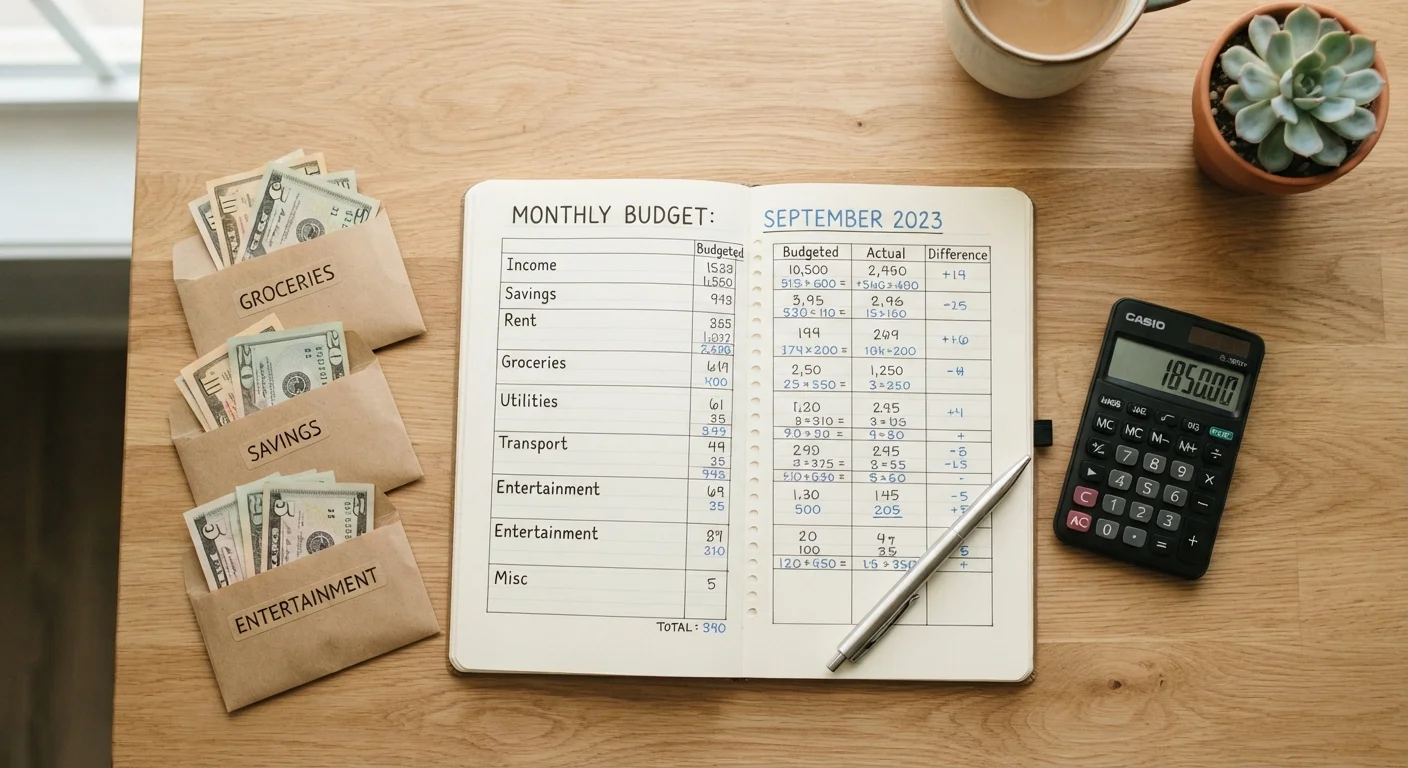
Envelope budgeting involves setting aside a fixed cash amount for each spending category at the start of the month. When the envelope is empty, no more money goes to that category. Traditionally done with physical cash and paper envelopes, the same logic can apply with separate bank accounts or digital tools.
This method is concrete and tactile, which is why it tends to help people who struggle with overspending in particular areas. Seeing a thin envelope signals a real constraint in a way that a credit card statement does not. The limitation is that it works less naturally for bills paid automatically or digitally.
Combining methods can work
Many people use pay-yourself-first for savings and envelope budgeting for two or three categories where they tend to overspend. Mixing approaches is fine as long as the logic is consistent and you can track it without confusion. Start with one method, run it for two to three months, then adjust.
Pay-yourself-first budgeting
Pay-yourself-first budgeting reverses the usual order. Instead of spending throughout the month and saving whatever remains, you move a set amount into savings or an investment account the moment income arrives. The rest is available to spend however you choose.
Because the savings transfer is automatic, this method removes the need for ongoing willpower. It suits people whose main problem is not overspending in specific categories but failing to save consistently. The method does require that your regular income covers fixed expenses after the savings transfer is made; otherwise, you may need to adjust the savings amount or revisit fixed costs.
For households carrying high-interest debt, the math on saving versus paying down debt depends on interest rates and personal goals. A licensed financial adviser can help weigh that tradeoff for your specific situation.
The content provided on our blog site traverses numerous categories, offering readers valuable and practical information. Readers can use the editorial team’s research and data to gain more insights into their topics of interest. However, they are requested not to treat the articles as conclusive. The website team cannot be held responsible for differences in data or inaccuracies found across other platforms. Please also note that the site might also miss out on various schemes and offers available that the readers may find more beneficial than the ones we cover.