


Start here
What a pay stub actually is
Next
Gross pay vs. net pay
Then
Federal and state tax withholdings
Dig deeper
FICA: Social Security and Medicare
Almost there
Other common deductions
Wrap up
How to check your stub for errors
What a pay stub actually is
A pay stub is the itemized record your employer provides each time you are paid. It documents your earnings for that pay period and lists every amount subtracted before you receive the remainder. Whether you are paid weekly, biweekly, or twice a month, the stub follows the same basic structure.
Pay stubs typically show two columns of figures: current period amounts and year-to-date totals. The year-to-date column accumulates every dollar earned and every deduction taken since January 1, which is useful when you need to verify your annual income or check that FICA contributions are tracking correctly.
Before reading the numbers, make sure your personal information is accurate: your legal name, last four digits of your Social Security number, and employee ID if one appears. A data entry error at setup can affect your tax records.
Gross pay
The total amount you earned in a pay period before any taxes or deductions are removed.
Net pay
The amount you actually receive after all taxes and deductions have been subtracted from gross pay.
FICA
A federal payroll tax that funds Social Security and Medicare programs; both employees and employers pay a share.
Withholding
Money your employer sends directly to the IRS or a state tax agency on your behalf, based on your W-4 instructions.
W-4
An IRS form you complete when you start a job that tells your employer how much federal income tax to withhold from each paycheck.
Pre-tax deduction
A deduction taken from gross pay before income taxes are calculated, which lowers the amount of wages subject to tax.
Gross pay vs. net pay
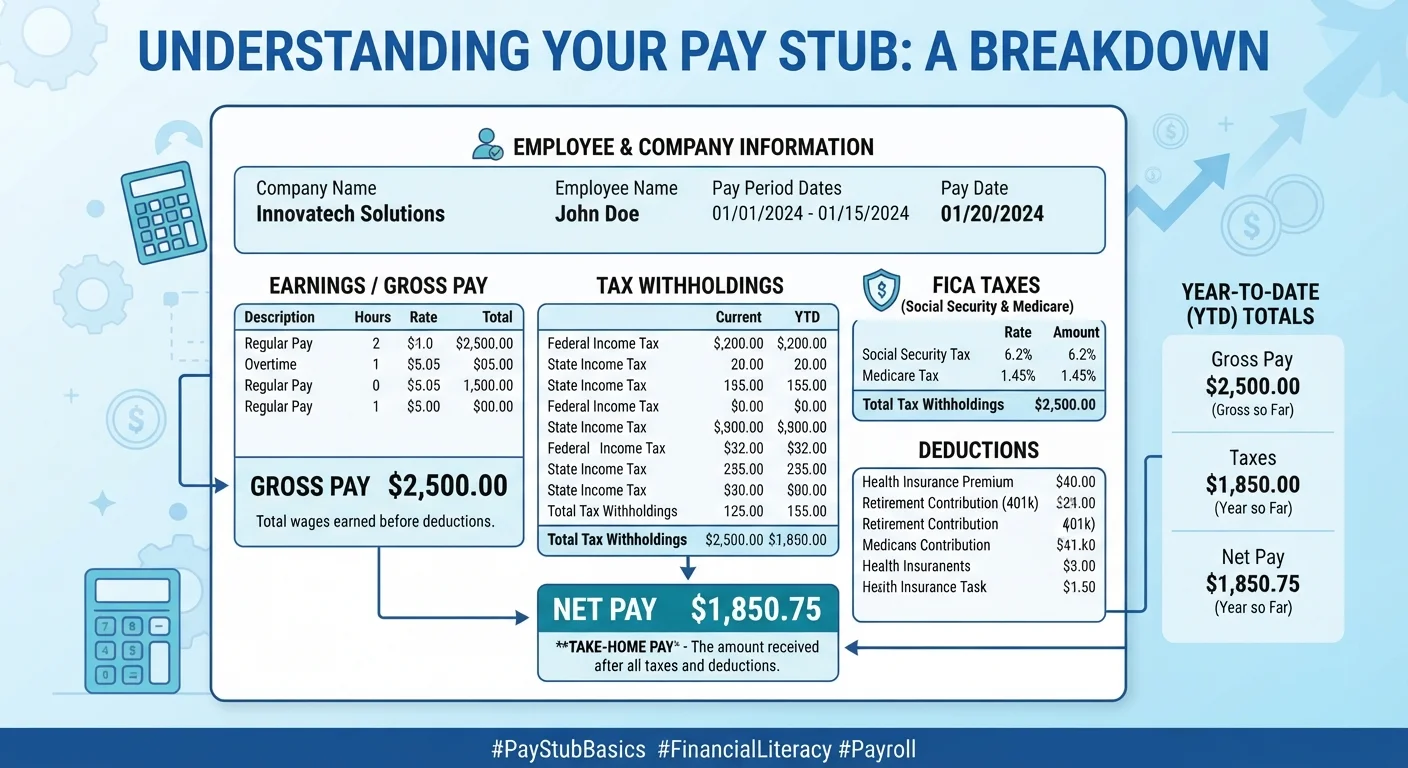
Gross pay is your wages before anything is removed. If your annual salary is $52,000 and you are paid biweekly, your gross pay each period is $2,000. Hourly workers see gross pay calculated as hours worked multiplied by their hourly rate, plus any overtime at the applicable rate.
Net pay is what transfers to your bank account. The difference between gross and net is the sum of all deductions, mandatory and voluntary. For most workers, net pay runs noticeably lower than gross pay, sometimes by 25 to 35 percent depending on income level, state of residence, and benefits elections.
For a broader grounding in financial terms, our personal finance vocabulary guide covers key concepts including net worth, cash flow, and other terms that connect to how your paycheck fits your overall financial picture.
Federal and state tax withholdings
Federal income tax withholding is calculated using the information you provided on your W-4 form. The IRS provides withholding tables that employers use to determine how much to hold back based on your filing status, pay frequency, and any adjustments you specified. Filing as single generally produces more withholding than filing as married; claiming additional deductions on the W-4 reduces withholding.
State income tax withholding appears as a separate line on your stub if you live in a state that levies an income tax. Nine states currently have no broad-based individual income tax, so residents of those states will not see this line. State withholding is based on the state equivalent of your W-4, sometimes called a state withholding certificate.
Under-withholding can lead to a tax bill
If your W-4 withholding is set too low, you may owe taxes plus a potential underpayment penalty when you file your annual return. If your financial situation changes, such as taking on a second job or a significant pay raise, consider reviewing your withholding with a tax professional.
FICA: Social Security and Medicare
FICA contributions appear as two separate deductions. The Social Security tax is 6.2% of gross wages up to an annual wage base limit set each year by the Social Security Administration. Once your year-to-date wages exceed that limit, the Social Security deduction stops for the rest of the calendar year. The Medicare tax is 1.45% of all covered wages with no cap.
Your employer matches both amounts, paying an equal share on your behalf directly to the IRS. High earners pay an additional 0.9% Medicare surtax on wages above $200,000 for single filers, which employers are required to withhold once that threshold is crossed in a calendar year.
Electronic pay stubs are standard
Most employers now provide pay stubs through an online payroll portal rather than on paper. Access is usually through an employee self-service site. Download and save a copy of each stub in a secure folder; you may need them for tax filing, loan applications, or rental agreements.
Other common deductions
Beyond taxes, your stub may show deductions for benefits you elected during open enrollment. Health, dental, and vision insurance premiums paid through an employer-sponsored plan are usually taken as pre-tax deductions, which lowers the wages subject to federal and state income tax. If you enrolled in a health plan through your job, our health insurance starter guide explains how employer-sponsored coverage works and what terms like deductible and copay mean.
Retirement contributions to a traditional 401(k) are also pre-tax, reducing your taxable wages for the period. Roth 401(k) contributions, by contrast, are taken after tax, so they do not reduce current taxable wages but grow tax-free. Other lines you might see include flexible spending account contributions, life insurance premiums, and any wage garnishments ordered by a court.
Review your first few stubs carefully
Payroll setup errors are most common in the first one to two pay periods at a new job. Confirm your name, Social Security number (last four digits), pay rate, and any benefit deductions match what you agreed to. Catching a mistake early reduces the correction work needed later.
How to check your stub for errors
Errors in payroll are more common than many workers realize. Check your gross pay against your agreed salary or hours worked. Confirm that your health insurance and retirement deductions match the amounts you elected. Compare year-to-date Social Security withholding against 6.2% of your year-to-date gross wages to spot over- or under-withholding.
If you find a discrepancy, contact your employer's payroll department in writing and keep a copy of your message. Corrections that affect your wages or withholding may require an amended W-2 at year end. Consulting a licensed tax professional is a practical step if the error involves multiple pay periods or a significant dollar amount. This article provides general information only and is not tax or financial advice; your specific situation may differ.
This article is for informational purposes only and does not constitute tax, legal, or financial advice. Consult a qualified tax professional or financial adviser for guidance specific to your circumstances.
Frequently Asked Questions
Your salary is your gross pay, the total before deductions. Federal and state income taxes, FICA contributions, and any benefits premiums are all subtracted before you receive the remainder. The gap is often larger than new employees expect.
FICA stands for the Federal Insurance Contributions Act. It covers two separate taxes: 6.2% of gross wages for Social Security (up to an annual wage base) and 1.45% for Medicare, with no wage cap.
Yes. Submit a new W-4 form to your employer at any time to adjust your withholding. Changing your withholding does not change your actual tax liability; it only changes how much is collected in advance each pay period.
Traditional 401(k) contributions come out before federal income tax is calculated, which lowers your taxable wages for that period. FICA taxes still apply to the full gross amount, however.
Contact your employer's payroll department in writing as soon as possible. Keep copies of all pay stubs as documentation. Errors in withholding or wage amounts may need to be corrected before you file your annual tax return.
The content provided on our blog site traverses numerous categories, offering readers valuable and practical information. Readers can use the editorial team’s research and data to gain more insights into their topics of interest. However, they are requested not to treat the articles as conclusive. The website team cannot be held responsible for differences in data or inaccuracies found across other platforms. Please also note that the site might also miss out on various schemes and offers available that the readers may find more beneficial than the ones we cover.