


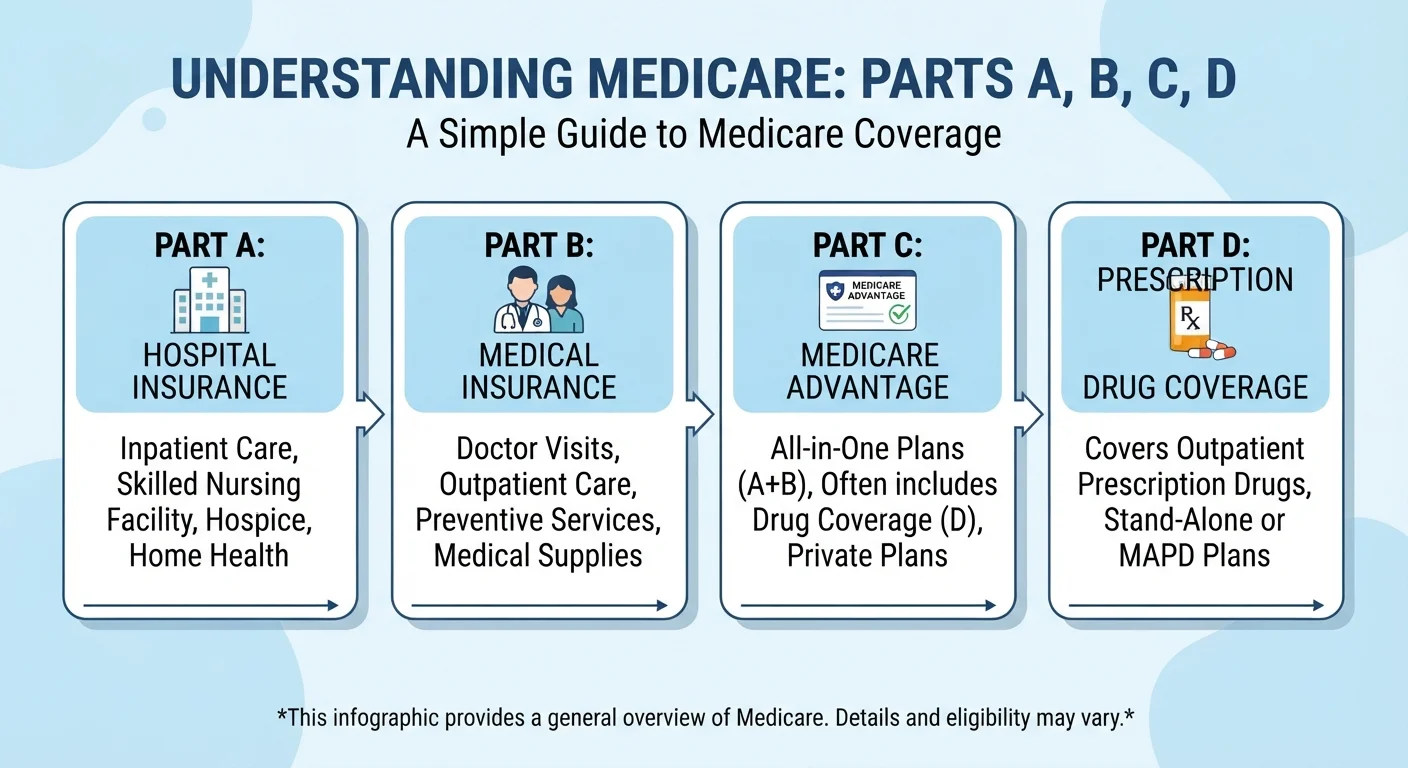
Part A: hospital and inpatient coverage
Part A covers inpatient hospital care, skilled nursing facility stays following a qualifying hospital admission, hospice care, and some home health services. Most people who have worked and paid Medicare taxes for at least 40 calendar quarters (roughly 10 years) pay no Part A premium. Those with fewer work credits pay a monthly premium set annually by CMS.
Part A does carry cost-sharing. Each benefit period begins when you are admitted to a hospital and ends after you have been out of a hospital or skilled nursing facility for 60 consecutive days. A deductible applies at the start of each benefit period, and daily coinsurance kicks in after 60 days in the hospital. There is no out-of-pocket maximum under Original Medicare, which is one reason many enrollees seek supplemental coverage.
Part B: medical and outpatient coverage
Part B covers medically necessary services provided outside a hospital: doctor visits, outpatient surgery, preventive screenings, lab tests, durable medical equipment, and mental health services. It also covers some home health care not tied to a hospital stay.
Unlike Part A, Part B always requires a monthly premium. The standard amount changes annually; higher-income enrollees pay an additional surcharge called the Income-Related Monthly Adjustment Amount (IRMAA). Part B also has an annual deductible, and enrollees pay 20% coinsurance on most services after meeting that deductible.
Declining Part B when first eligible is possible but carries risk. If you do not have creditable employer-sponsored coverage, delaying enrollment triggers a permanent late-enrollment penalty of 10% added to your premium for each full 12-month period you were eligible but not enrolled.
Part C: Medicare Advantage
Part C, commonly called Medicare Advantage, lets private insurers approved by CMS deliver your Part A and Part B benefits in a single plan. Most Medicare Advantage plans also bundle Part D drug coverage. Some include added benefits such as dental or vision, though the scope and cost of those benefits vary widely by plan and location.
Medicare Advantage plans typically use networks of doctors and hospitals. Many plans charge little or no additional monthly premium beyond the Part B premium you continue to pay, but they impose their own deductibles, copayments, and coinsurance structures. These plans must cap out-of-pocket costs each year, which Original Medicare does not do on its own.
Medicare Advantage vs. Medigap: different approaches
Medicare Advantage replaces Original Medicare through a private plan, while Medigap supplements Original Medicare by helping pay cost-sharing. You cannot hold both a Medicare Advantage plan and a Medigap policy at the same time. Reviewing Medigap plan factors is a separate process from evaluating Medicare Advantage options.
Choosing between Original Medicare and Medicare Advantage involves trade-offs that depend on your health needs, preferred doctors, and location. This article provides general education; consult a licensed insurance counselor or the State Health Insurance Assistance Program (SHIP) in your state for guidance on your own situation.
Part D: prescription drug coverage
Part D adds prescription drug coverage through private insurers. Anyone enrolled in Original Medicare can add a standalone Part D plan. Those in a Medicare Advantage plan that already includes drug coverage generally cannot also enroll in a standalone Part D plan.
Each Part D plan has a formulary, a list of covered drugs organized into pricing tiers. Premiums, deductibles, and copayments differ across plans. Like Part B, Part D carries a late-enrollment penalty for those who go without creditable drug coverage for 63 or more consecutive days after becoming eligible.
Social Security retirement timing can affect when you become eligible for Medicare and, in turn, when your enrollment windows open. Planning both decisions together may help you avoid coverage gaps.
This article is for general informational purposes only and does not constitute personalized insurance, financial, or legal advice. Coverage rules, costs, and eligibility requirements can change. Consult a licensed insurance professional or visit Medicare.gov for information specific to your situation.
Frequently Asked Questions
You are automatically enrolled in Parts A and B if you already receive Social Security benefits before turning 65. If you are not yet receiving Social Security, you must actively enroll during your Initial Enrollment Period, which spans seven months around your 65th birthday.
Original Medicare generally does not cover routine dental, vision, or hearing care, long-term custodial care in a nursing home, or care received outside the United States. See <a href="/senior/medicare-coverage-misconceptions-surprise-costs">common Medicare coverage misconceptions</a> for a fuller breakdown of gaps that can lead to surprise costs.
No. If you enroll in a Medicare Advantage (Part C) plan, that plan takes over your Part A and Part B benefits. You are technically still enrolled in Medicare, but your coverage is delivered through the private plan rather than directly by the federal government.
The standard Part B monthly premium is set annually by CMS and is subject to change each year. Higher-income enrollees pay an Income-Related Monthly Adjustment Amount (IRMAA) on top of the standard premium. Check the CMS website or Medicare.gov for the current year's figures.
No. Medigap (also called Medicare Supplement Insurance) is private coverage that works alongside Original Medicare to help pay costs such as deductibles and coinsurance. Medicare Advantage replaces Original Medicare. The two approaches are mutually exclusive. <a href="/senior/evaluating-medicare-supplement-medigap-plan">Evaluating a Medigap plan</a> requires weighing different factors than evaluating a Medicare Advantage plan.
Medicare is an age- and disability-based federal program. Medicaid is a joint federal-state program based on income and assets, covering long-term care costs that Medicare largely does not. Some people qualify for both programs simultaneously. <a href="/senior/medicaid-long-term-care-coverage-eligibility">Medicaid's long-term care coverage rules</a> differ substantially from Medicare's.
The content provided on our blog site traverses numerous categories, offering readers valuable and practical information. Readers can use the editorial team’s research and data to gain more insights into their topics of interest. However, they are requested not to treat the articles as conclusive. The website team cannot be held responsible for differences in data or inaccuracies found across other platforms. Please also note that the site might also miss out on various schemes and offers available that the readers may find more beneficial than the ones we cover.