


How Social Security retirement benefits work
Social Security retirement benefits are monthly payments funded through payroll taxes. Workers pay into the system throughout their careers, and the Social Security Administration (SSA) uses that earnings record to calculate a benefit when a worker retires. The program is administered by the federal government and governed by Title II of the Social Security Act.
To qualify for retirement benefits, a worker generally needs 40 credits, which are earned by working and paying Social Security taxes. In 2024, one credit equals $1,730 in covered earnings, and a worker can earn at most four credits per year. Most workers reach the 40-credit threshold after roughly 10 years in the workforce.
Benefits are not a flat dollar amount. The SSA calculates your primary insurance amount (PIA) using your 35 highest-earning years, adjusted for wage inflation. If you worked fewer than 35 years, the SSA fills the remaining years with zeros, which lowers the average and reduces your benefit. This is why a longer work history generally produces a higher monthly payment.
| Minimum credits to qualify | 40 credits (roughly 10 years of work) (Social Security Administration) |
| Earliest claiming age | 62 (with permanent reduction) (Social Security Administration) |
| Full retirement age (born 1960 or later) | 67 (Social Security Administration) |
| Maximum delayed retirement credit | 8% per year, up to age 70 (Social Security Administration) |
| Years used in benefit calculation | 35 highest-earning years (Social Security Administration) |
| Maximum spousal benefit at FRA | 50% of worker's primary insurance amount (Social Security Administration) |
When you can claim and what claiming age costs or gains
Workers can begin receiving Social Security retirement benefits as early as age 62, but doing so permanently reduces the monthly amount. The SSA sets a full retirement age (FRA) based on birth year. For anyone born in 1960 or later, the FRA is 67.
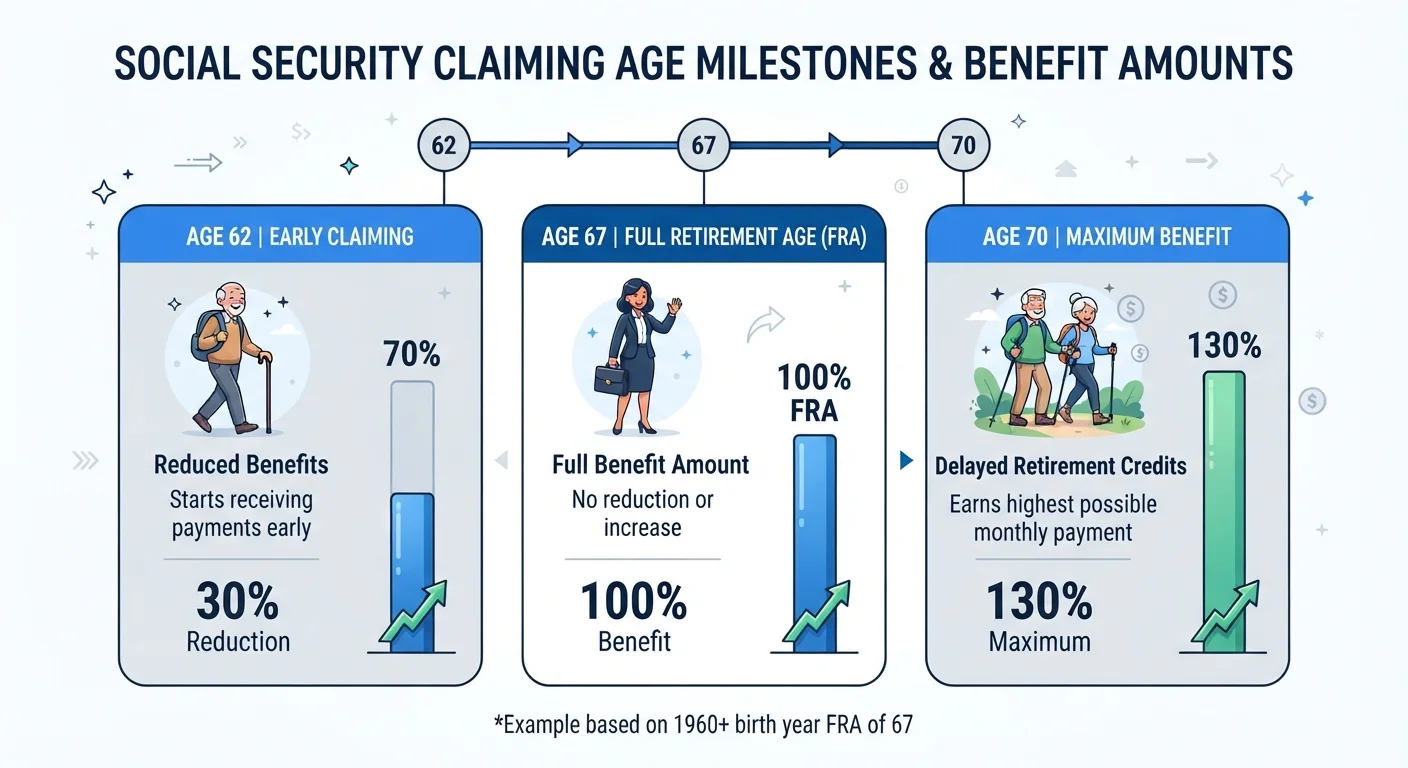
Claiming at 62 instead of 67 can reduce monthly benefits by up to 30 percent. Conversely, delaying past the FRA earns delayed retirement credits of 8 percent per year, up to age 70. There is no financial benefit to waiting beyond age 70. See how claiming age and work history shape your monthly amount for a closer look at the trade-offs involved.
The right claiming age depends on individual health, other income sources, and household circumstances. This article provides general education only. A licensed financial adviser or Social Security-certified counselor can help you evaluate your specific situation.
Spousal, survivor, and dependent benefits
Social Security retirement is not limited to the worker. A spouse who did not work, or who earned significantly less, may claim a spousal benefit worth up to 50 percent of the worker's PIA at the spouse's FRA. Claiming that spousal benefit before the spouse's own FRA reduces the amount permanently.
Survivor benefits allow a widow or widower to receive up to 100 percent of the deceased worker's benefit, subject to age and eligibility rules. Dependent children under 18, or disabled children of any age if the disability began before 22, may also qualify for benefits on a parent's record.
SSI (Supplemental Security Income) is a separate program entirely and is often confused with Social Security retirement. The two programs have different eligibility rules and funding sources. See how SSI and Social Security retirement differ for a clear side-by-side comparison.
Taxes, Medicare, and planning considerations
Social Security benefits may be partially taxable at the federal level. If your combined income (adjusted gross income plus nontaxable interest plus half of your Social Security benefit) exceeds $25,000 for single filers or $32,000 for married couples filing jointly, up to 50 percent of benefits may be taxable. Above $34,000 (single) or $44,000 (married), up to 85 percent may be taxable. State tax treatment varies.
Medicare eligibility begins at 65 regardless of when you claim Social Security. However, if you start Social Security before 65, Medicare Part B premiums are automatically deducted from your benefit once you enroll. Understanding what each part of Medicare covers and costs is worthwhile when planning how your income and expenses will interact in retirement.
Before finalizing any retirement income strategy, review financial decisions that can quietly affect retirement readiness and consider how Social Security fits alongside savings and other income. A practical next step is mapping those sources to monthly expenses, which a fixed-income budget framework can help you do.
This article is for general informational purposes only and does not constitute financial, tax, or legal advice. Social Security rules are subject to change. Consult a licensed financial adviser or contact the Social Security Administration directly at ssa.gov for guidance specific to your situation.
The content provided on our blog site traverses numerous categories, offering readers valuable and practical information. Readers can use the editorial team’s research and data to gain more insights into their topics of interest. However, they are requested not to treat the articles as conclusive. The website team cannot be held responsible for differences in data or inaccuracies found across other platforms. Please also note that the site might also miss out on various schemes and offers available that the readers may find more beneficial than the ones we cover.