


Start here
How your benefit amount is calculated
Next
How your claiming age changes your monthly payment
Then
Factors beyond age that affect your benefit
Also consider
Spousal and survivor benefits
When you're ready
Steps to take before you claim
How your benefit amount is calculated
Social Security retirement benefits are based on your personal earnings history. The Social Security Administration (SSA) looks at your 35 highest-earning years, adjusts each year's wages for inflation, and produces a figure called your Average Indexed Monthly Earnings, or AIME. A formula then converts your AIME into your Primary Insurance Amount (PIA), which is the benefit you would receive at your exact full retirement age.
If you worked fewer than 35 years, the SSA fills in zeros for the missing years, which lowers your AIME and therefore your PIA. Working longer, or earning more in your remaining working years, can raise it. The SSA recalculates your benefit each year you continue working, so late-career earnings can still improve your amount.
Full retirement age (FRA)
The age at which you qualify for your full, unreduced Social Security retirement benefit. It is set by law and depends on your birth year.
Primary Insurance Amount (PIA)
The monthly benefit you would receive if you claim exactly at your full retirement age. It is the starting point for calculating any reductions or increases.
AIME
Average Indexed Monthly Earnings. The Social Security Administration uses this figure, calculated from your work history, to determine your base benefit.
Delayed retirement credits
Extra benefit percentage points added to your payment for each month you wait to claim past your full retirement age, up to age 70.
Spousal benefit
A Social Security benefit available to the spouse of a retired worker, up to 50 percent of the worker's full retirement benefit.
For a broader overview of how these calculations connect to your overall retirement picture, see our retirement budget planning guide, which covers how Social Security fits alongside other income sources.
How your claiming age changes your monthly payment
You may begin claiming as early as age 62 or as late as age 70. Claiming before your full retirement age reduces your monthly payment permanently. Claiming after your full retirement age increases it through delayed retirement credits.
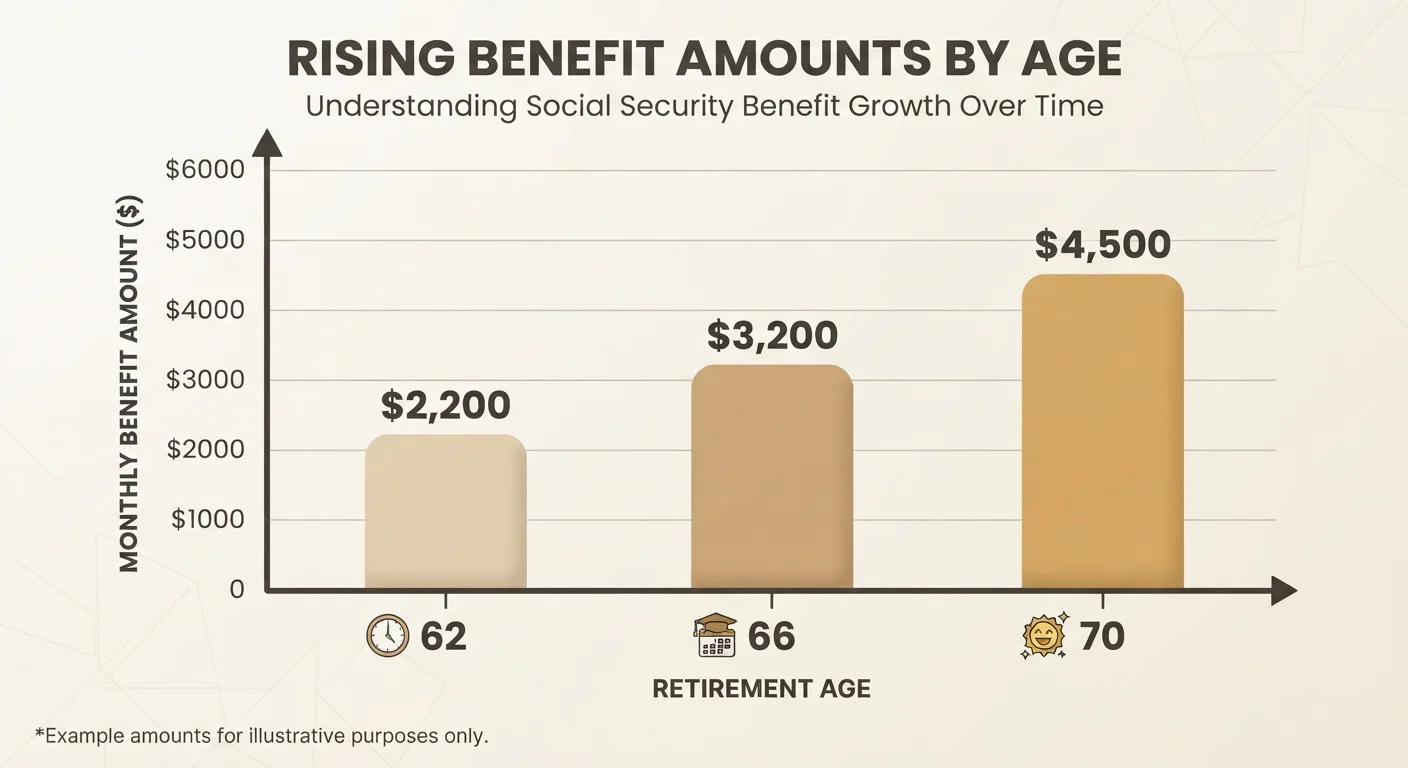
The reduction for early claiming depends on how many months before your FRA you start. For someone with an FRA of 67, claiming at 62 reduces the benefit by up to 30 percent. Claiming at 64 results in a smaller reduction. These percentages are set by law and do not change once your benefit begins.
Delayed retirement credits add roughly 8 percent per year for each year you wait past your FRA, up to age 70. After 70, no additional credits accumulate, so there is no financial gain from waiting longer.
Early claiming is permanent
Claiming benefits before your full retirement age locks in a reduced monthly payment for life. There are limited circumstances where you can withdraw an application, but the window is narrow and the rules are strict. Review your options with the Social Security Administration or a qualified adviser before submitting your claim.
There is no universally correct claiming age. Someone in good health with no immediate financial need may gain more from waiting. Someone managing a fixed budget or a health condition may find earlier claiming practical. The SSA provides a benefits calculator at ssa.gov to help you compare monthly amounts at each possible age.
Factors beyond age that affect your benefit
Several other factors shape what you actually receive each month.
- Earnings during retirement: If you claim before your FRA and continue to work, the SSA may temporarily withhold part of your benefit if your annual wages exceed a set threshold. Once you reach FRA, this earnings test no longer applies.
- Taxes: Depending on your total income in retirement, up to 85 percent of your Social Security benefit may be subject to federal income tax. State tax rules vary. A tax professional can clarify what applies to your situation.
- Medicare premiums: If you are enrolled in Medicare Part B, the premium is typically deducted directly from your Social Security payment, which affects your net monthly deposit.
- Cost-of-living adjustments (COLA): The SSA adjusts benefits annually based on changes in the Consumer Price Index. These adjustments apply to benefits already in payment and to future benefit amounts.
For more on how the program works at a foundational level, our article on Social Security retirement benefits covers earning credits and the claims process in more detail.
Check your earnings record regularly
Errors in your Social Security earnings record can lower your eventual benefit. You can review your record for free at ssa.gov by creating a my Social Security account. Catching and correcting mistakes early is much easier than disputing them after you retire.
Spousal and survivor benefits
Social Security includes benefits designed for spouses and surviving spouses, which matter particularly for households where one partner had lower or no earnings.
A spouse who has not worked, or who worked fewer years, may claim up to 50 percent of their partner's PIA. The spouse must be at least 62 to claim, and claiming before their own FRA reduces the spousal benefit. Claiming on a spouse's record does not reduce the working spouse's own benefit.
Divorced spouses may also qualify for benefits on an ex-spouse's record if the marriage lasted at least 10 years, they are currently unmarried, and both parties are at least 62.
Survivor benefits work differently. A surviving spouse may claim as early as age 60 (or 50 with a qualifying disability) and may receive up to 100 percent of the deceased spouse's benefit, depending on when the survivor claims. This can be a meaningful source of income for widows and widowers.
If you are sorting out the difference between Social Security retirement and Supplemental Security Income, our article on SSI vs. Social Security retirement explains how the two programs work separately and how they can overlap.
Steps to take before you claim
Before submitting a claim, a few practical steps can help you make a more informed decision.
- Review your earnings record on ssa.gov to confirm it is accurate. Errors in past wages can reduce your benefit.
- Use the SSA's online Retirement Estimator to see your projected monthly amount at ages 62, your FRA, and 70.
- Consider how your benefit fits into your total monthly budget. The retirement budget planning framework on this site can help you map fixed income to regular expenses.
- Talk with a licensed financial adviser or contact the SSA directly (1-800-772-1213) if you have questions about your specific situation, spousal benefits, or the interaction with Medicare.
This article is for general informational purposes only and does not constitute financial, legal, or tax advice. Social Security rules are complex and individual circumstances vary. Please consult a qualified financial adviser or contact the Social Security Administration directly for guidance specific to your situation.
Frequently Asked Questions
You can begin claiming Social Security retirement benefits at age 62. However, claiming before your full retirement age results in a permanently reduced monthly payment, so it is worth reviewing your options carefully before deciding.
If you claim before your full retirement age and continue working, the Social Security Administration may temporarily withhold part of your benefit if your earnings exceed a set threshold. Once you reach full retirement age, earnings no longer reduce your payment.
Full retirement age (FRA) depends on your birth year. For people born in 1960 or later, FRA is 67. For those born between 1943 and 1954, it is 66. The Social Security Administration website has a full chart by birth year.
Yes. A spouse may be eligible for up to 50 percent of their partner's full retirement benefit, depending on their own record and claiming age. Divorced spouses may also qualify under certain conditions.
For each month you delay claiming past your full retirement age, your benefit grows by a small percentage. This adds up to roughly 8 percent per year, capping at age 70 after which no further increases accrue.
You can view your estimated benefit at different claiming ages by creating a free account on the Social Security Administration's official website, ssa.gov. Your statement shows estimates based on your actual earnings record.
The content provided on our blog site traverses numerous categories, offering readers valuable and practical information. Readers can use the editorial team’s research and data to gain more insights into their topics of interest. However, they are requested not to treat the articles as conclusive. The website team cannot be held responsible for differences in data or inaccuracies found across other platforms. Please also note that the site might also miss out on various schemes and offers available that the readers may find more beneficial than the ones we cover.