


Our Verdict
No single internet type is the right choice for every home. Availability narrows your options first, then speed needs and contract terms should guide your decision. Comparing total monthly cost, including equipment rental and any data overage fees, gives a more accurate picture than the base rate alone.
| Best for | Recommended |
|---|---|
| Households that stream, game, or work from home with multiple users | Fiber |
| Urban or suburban homes where fiber is unavailable | Cable |
| Rural homes with limited infrastructure | Fixed wireless |
| Light users in areas where only phone-line service is available | DSL |
How the four main connection types work
Home internet arrives through four common delivery methods, each with a different infrastructure and a different set of trade-offs.
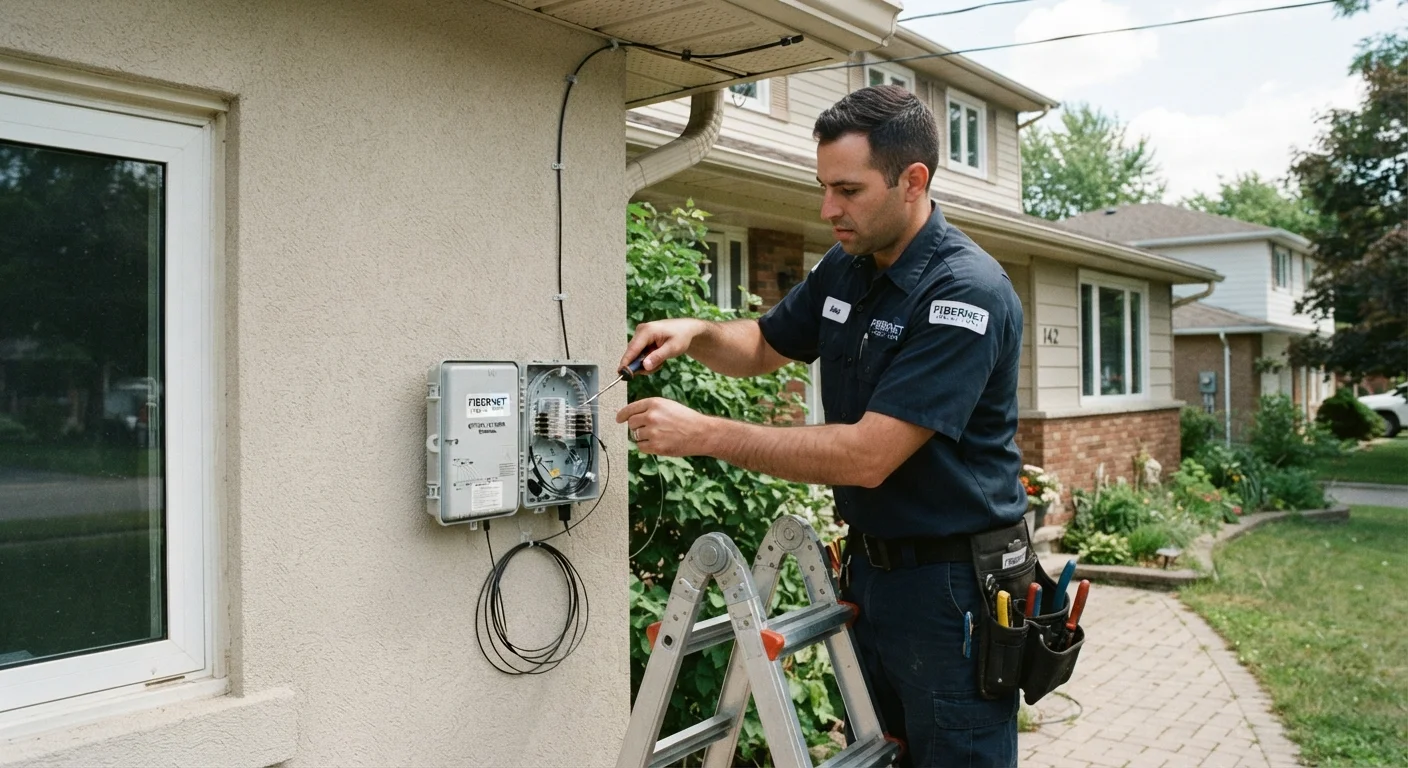
Fiber optic transmits data as pulses of light through glass or plastic strands. Because light signal does not degrade the way electrical signal does, fiber connections typically hold their advertised speeds even during peak hours. Upload and download speeds are often symmetrical, which matters for video calls and file transfers.
Cable runs over the same coaxial lines used for cable television. It is widely available in urban and suburban neighborhoods. Cable connections share bandwidth among nearby subscribers, so speeds can slow during high-demand periods in the evening.
DSL (digital subscriber line) carries data over copper phone lines already installed in most homes. Because signal strength weakens over distance, homes farther from a provider's central hub tend to see lower speeds. DSL is often the only wired option in areas that have not received cable or fiber upgrades.
Fixed wireless sends a signal from a tower to a receiver mounted on or near the home, then distributes it through an indoor router. It requires a clear line of sight to the tower and can be affected by weather, but it reaches locations where burying cable is not practical.
Speed and reliability by connection type
Speed needs vary by household. A single person checking email and streaming video at standard definition needs far less bandwidth than a family with four people videoconferencing, gaming, and streaming simultaneously.
Fiber connections commonly range from 100 Mbps to several gigabits per second, and the speeds are generally stable. Cable plans cover a similar range but can fluctuate. DSL plans often top out below 100 Mbps, though newer DSL variants such as VDSL2 can reach higher in the right conditions. Fixed wireless plans vary widely by provider and tower proximity, typically landing between 25 Mbps and 300 Mbps.
For context, the Federal Communications Commission defines broadband as a minimum of 100 Mbps download and 20 Mbps upload for a typical household, a threshold updated in 2024. Fixed wireless and DSL connections may fall short of that threshold depending on location.
| Fiber | Cable | DSL | Fixed wireless | |
|---|---|---|---|---|
| Typical download speed | 100 Mbps to 5 Gbps | 25 Mbps to 1 Gbps | 1 Mbps to 100 Mbps | 25 Mbps to 300 Mbps |
| Upload speed | Often symmetrical | Lower than download | Lower than download | Varies |
| Peak-hour consistency | Generally stable | Can slow | Generally stable | Weather-dependent |
| Availability | Growing, urban focus | Wide suburban coverage | Very wide | Rural and underserved areas |
| Data caps | Rare | Common | Common | Common |
| Typical contract options | Month-to-month or term | Month-to-month or term | Often term | Often term |
Contract terms and total cost
The advertised monthly rate rarely reflects the full cost. Equipment rental fees for a modem or router can add $10 to $20 per month. Promotional rates often increase after 12 to 24 months. Some plans include data caps that trigger overage charges or speed throttling once you exceed a monthly limit.
Before signing, check whether the plan requires a one- or two-year contract and what the early termination fee is. Month-to-month plans exist but sometimes carry a higher base rate. If you are moving to a new home, confirming service availability before your move date saves delays. The utilities and services transfer checklist covers how to coordinate internet setup alongside other accounts during a move.
Reading the contract carefully applies beyond internet service. The same habit of checking auto-renewal clauses and cancellation windows is worth developing for any home service agreement. Lawn care service contracts are one example where these terms catch people off guard.
Ask about total monthly cost upfront
Request an itemized quote that includes equipment rental, taxes, and any fees not in the base rate. Ask specifically when the promotional rate ends and what the standard rate will be. Getting this in writing before you sign gives you a clear baseline for comparison.
Considerations for rural households and seniors
Rural addresses frequently have fewer options. Fixed wireless and satellite are the most common alternatives where cable and fiber have not been built out. Satellite internet has improved in speed and latency in recent years, though it remains a separate category with distinct cost and equipment considerations.
Seniors who rely on internet access for telehealth appointments, prescription management, or staying connected with family may find that a faster, more stable connection directly affects those activities. For households weighing longer-term decisions about where to live, internet access is one factor among many. The aging in place versus assisted living comparison touches on how infrastructure and services factor into that decision.
Low-income households may qualify for federal subsidy programs that reduce monthly costs. The FCC's Affordable Connectivity Program and similar initiatives have provided discounts in the past; eligibility rules and program availability change, so checking directly with the FCC or a local provider gives the current picture.
The content provided on our blog site traverses numerous categories, offering readers valuable and practical information. Readers can use the editorial team’s research and data to gain more insights into their topics of interest. However, they are requested not to treat the articles as conclusive. The website team cannot be held responsible for differences in data or inaccuracies found across other platforms. Please also note that the site might also miss out on various schemes and offers available that the readers may find more beneficial than the ones we cover.