


How Medicaid differs from Medicare for long-term care
Many families assume Medicare will pay for a parent's nursing home stay. That assumption leads to painful surprises. Medicare covers short-term skilled nursing care after a hospital stay, but it stops paying once the person no longer needs skilled treatment such as physical therapy or wound care. The ongoing help with daily living that most nursing home residents need is called custodial care, and Medicare does not cover it.
Medicaid fills that gap. It is the single largest public payer for long-term custodial care in the United States. Because both programs involve government coverage, they are easy to confuse. Our article on common Medicare coverage misconceptions breaks down what Medicare actually pays for, which can help clarify where Medicaid takes over.
What Medicaid covers in long-term care settings
Medicaid covers a broad set of long-term care services, though the exact list depends on the state where a person lives.
Nursing facility care
For people who qualify, Medicaid pays for room, board, and nursing services at a Medicaid-certified nursing facility. This includes meals, medication management, and help with bathing, dressing, and mobility. A resident generally contributes most of their monthly income toward the cost, keeping only a small personal needs allowance set by the state.
Home- and community-based services
Many states have expanded Medicaid through waiver programs that pay for care at home or in community settings. These programs may cover personal care aides, homemaker services, adult day health programs, and minor home modifications to support safety. Waiver programs often have waiting lists, so applying early matters.
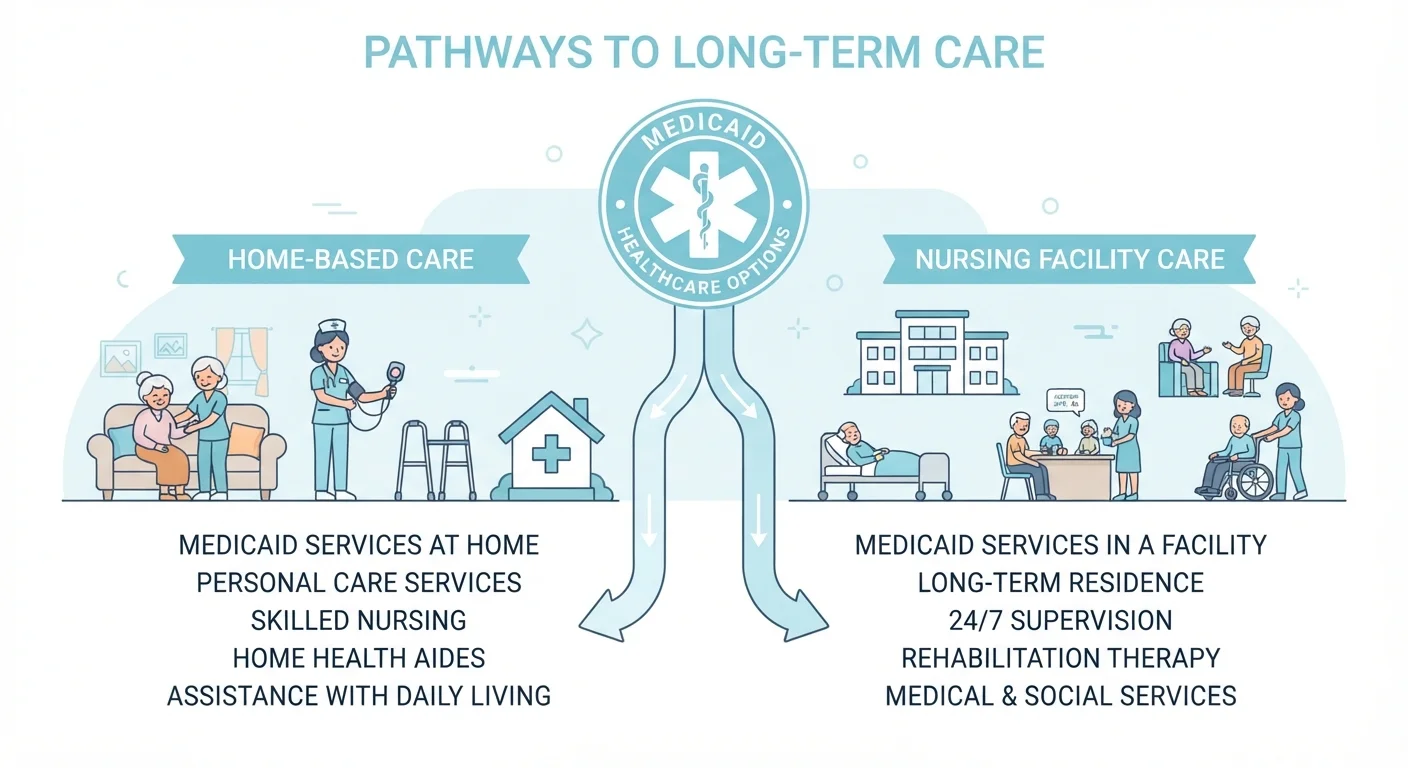
Whether nursing facility care or home-based support fits a family's situation better is worth thinking through carefully. Our article on aging in place versus assisted living walks through the financial and practical trade-offs involved.
General eligibility rules
Medicaid eligibility for long-term care involves two main tests: income and assets. Both thresholds are set at the state level within federal guidelines, so the numbers below are general guidance, not guaranteed limits for any specific state.
Income limits
Most states use a monthly income cap. In states that follow the income cap model, a person whose income exceeds the limit may still qualify by setting up a qualifying income trust (sometimes called a Miller trust), which redirects excess income through a legal account. A licensed elder law attorney can explain whether this applies in your state.
Asset limits
Medicaid counts most owned assets, including savings accounts, investment accounts, and additional real property. The asset limit for a single applicant is typically around $2,000 in many states, though some states allow more. A primary home, one vehicle, personal belongings, and some prepaid burial plans are usually exempt.
Contact your state's SHIP program
State Health Insurance Assistance Programs (SHIP) offer free, one-on-one counseling on Medicare and Medicaid options. Counselors are not affiliated with insurance companies or financial products. Find your local SHIP through the Eldercare Locator at eldercare.acl.gov or by calling 1-800-677-1116.
Spousal protections
Federal rules protect a spouse who remains in the community when their partner enters a nursing home on Medicaid. The community spouse can keep a portion of joint assets, called the Community Spouse Resource Allowance, and a minimum monthly income. This prevents one health crisis from leaving a healthy spouse financially depleted.
The look-back period
Medicaid reviews the prior 60 months of financial transactions when someone applies for long-term care benefits. Gifts or asset transfers made for less than fair market value during that window can trigger a period of ineligibility. Certain transfers, such as those made to a spouse or a blind or disabled child, are typically exempt from this rule.
Steps families can take now
Medicaid planning works best when it begins well before a care need arises. A licensed elder law attorney or a State Health Insurance Assistance Program (SHIP) counselor can help a family understand their state's specific rules and any planning strategies that may be available. SHIP counselors provide free, unbiased help and can be found through the Eldercare Locator, a service of the U.S. Administration on Aging.
Families weighing long-term insurance options alongside Medicaid may also want to review how supplemental coverage works. Our article on evaluating Medicare supplement plans covers how Medigap fits into the broader coverage picture, which is useful context even though Medigap itself does not cover long-term custodial care.
This article is for general informational purposes only and is not legal, financial, or medical advice. Medicaid rules vary significantly by state and individual circumstances. Consult a licensed elder law attorney, certified benefits counselor, or qualified financial adviser before making decisions about long-term care planning or Medicaid eligibility.
Frequently Asked Questions
Medicare covers short-term skilled nursing facility stays, generally up to 100 days after a qualifying hospital admission, and only while the person still needs skilled care. It does not pay for ongoing custodial or long-term nursing home care. For more detail, see our article on <a href="/senior/medicare-coverage-misconceptions-surprise-costs">common Medicare coverage misconceptions</a>.
Medicaid counts most assets you can convert to cash, including bank accounts, investments, and additional real estate. A primary home, one vehicle, personal belongings, and certain retirement accounts may be exempt, depending on state rules. Asset rules are complex, so consulting a licensed elder law attorney or benefits counselor is advisable.
Federal rules include spousal protection provisions. A community spouse (the one remaining at home) can generally keep the primary residence and a protected share of joint assets, called the Community Spouse Resource Allowance. The exact amount varies by state.
A Medicaid waiver is a state-run program that uses Medicaid funding to pay for home- and community-based services as an alternative to nursing home care. Services can include personal care aides, adult day programs, and home modifications. Not all states offer the same waivers, and many have waiting lists.
When you apply for Medicaid long-term care, the program reviews asset transfers made in the previous 60 months (five years) for most states. Transfers made for less than fair market value during that window can result in a period of ineligibility. Certain transfers, such as those to a spouse, are generally exempt.
The content provided on our blog site traverses numerous categories, offering readers valuable and practical information. Readers can use the editorial team’s research and data to gain more insights into their topics of interest. However, they are requested not to treat the articles as conclusive. The website team cannot be held responsible for differences in data or inaccuracies found across other platforms. Please also note that the site might also miss out on various schemes and offers available that the readers may find more beneficial than the ones we cover.