

Why transportation planning matters for older adults
For many older adults, giving up the car keys is one of the most significant life changes they face. It can affect access to medical appointments, grocery stores, social activities, and family visits. Yet the range of alternatives available in most communities is wider than many people realize, and a number of programs are specifically designed to keep costs low or eliminate them entirely.
This overview covers the main categories of senior transportation resources, what each one generally involves, and how to find what is available where you live. Transportation choices also connect to bigger decisions about where to live as you age. If that broader question is on your mind, the article on aging in place vs. assisted living looks at those trade-offs in detail.

Costs for any transportation program vary widely by location, income, and the specific service. General financial planning resources, such as the guide on retirement budget planning on a fixed income, can help you think through how transportation expenses fit into your overall monthly picture.
Transportation options available to most seniors
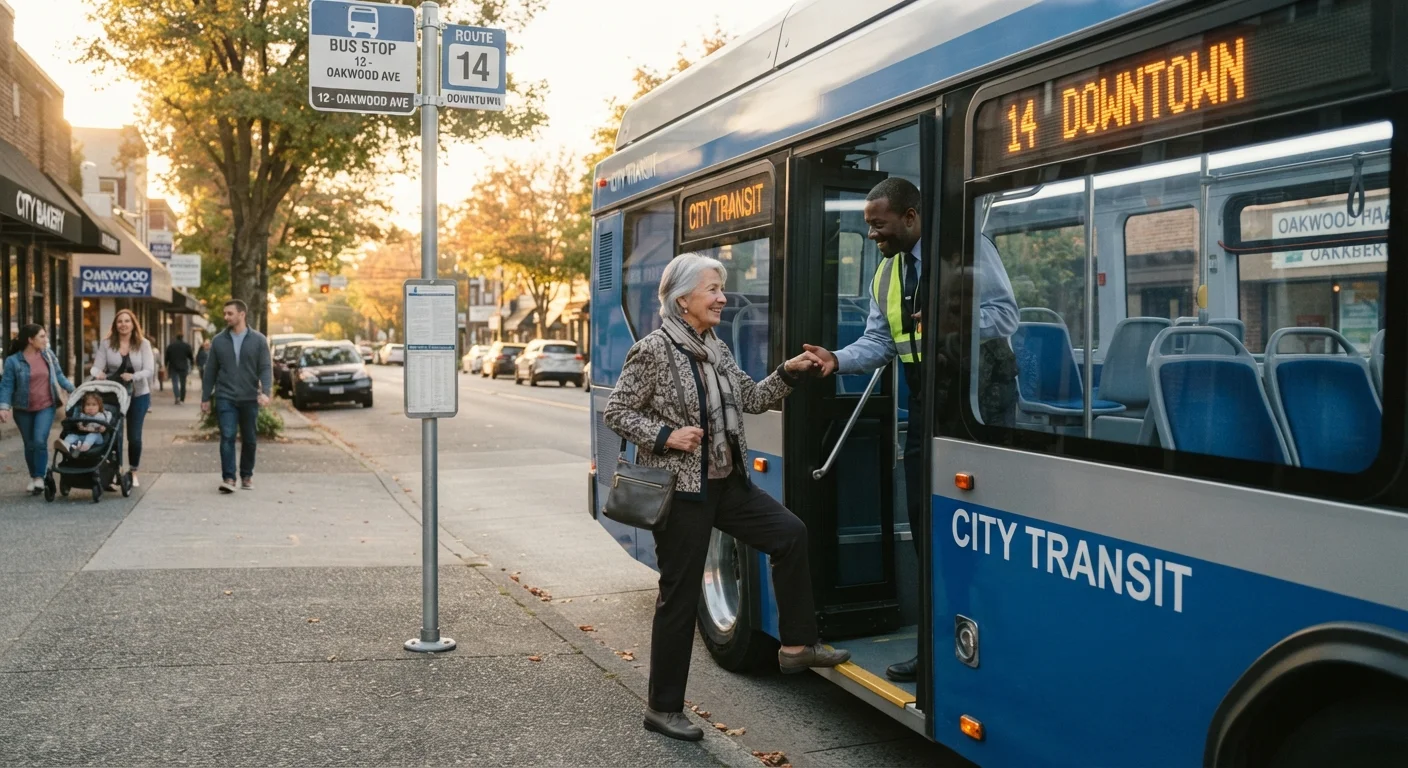
Fixed-route public transit with senior fare programs
Most city and regional transit systems offer reduced fares for adults aged 65 and older, and some extend those discounts to adults with disabilities regardless of age. The fare reduction can be substantial, sometimes 50 percent or more of the standard price, though the exact amount depends entirely on the transit agency.
To use reduced-fare transit, you typically need to apply for a senior fare card through the transit authority and carry it when you board. Requirements usually include proof of age, such as a government-issued ID. Applications are often available online, at transit offices, or through senior centers.
Most city transit systems offer reduced fares for adults 65 and older, sometimes 50 percent off standard prices.
Paratransit services for people with disabilities
The Americans with Disabilities Act (ADA) requires transit agencies that operate fixed-route systems to provide complementary paratransit service. Paratransit is door-to-door or curb-to-curb shared van or car service for people whose disability prevents them from using standard buses or trains.
Eligibility is based on functional ability, not age alone. Older adults who qualify due to a mobility or cognitive condition can use paratransit to reach medical appointments, pharmacies, and other destinations. The service generally operates within a defined area around fixed transit routes and requires advance booking, often 24 hours ahead.
ADA paratransit is available in most areas served by public transit and is based on functional ability, not age.
Volunteer driver networks
Many communities have nonprofit or faith-based programs that match older adults with volunteer drivers for rides to medical appointments, errands, and social events. These programs often serve rural and suburban areas where public transit is limited or absent.
Costs vary. Some programs are completely free; others ask for a small suggested donation or mileage contribution. The National Volunteer Transportation Center maintains information on programs by state, and local senior centers often keep updated lists as well.
Volunteer driver programs often reach rural and suburban areas where fixed-route transit is limited or unavailable.
Senior center and community shuttle programs
Many senior centers and community organizations operate their own shuttle or van services. These typically run on set schedules and cover regular routes to grocery stores, medical facilities, community events, and the senior center itself.
Eligibility is often open to any older adult in the service area, and fees, if any, are generally low. Your local parks and recreation department, senior center, or city government website is the right place to ask about schedules and sign-up procedures.
Community shuttles often serve grocery stores, medical facilities, and senior centers on predictable weekly schedules.
Ride-hailing apps and nonprofit ride programs
Commercial ride-hailing services are available in most metropolitan and many suburban areas and can be useful for trips that do not fit a fixed schedule. Some transit agencies have partnered with ride-hailing companies to extend coverage in areas with limited bus or train service, sometimes subsidizing the fare for eligible riders.
Separately, several nonprofit organizations operate their own ride platforms designed with older adults in mind. These may offer phone-based booking for seniors who prefer not to use a smartphone app, trained drivers who assist passengers from door to door, and flat or income-based pricing. Availability is geographically uneven, so checking with your local AAA is the most reliable way to find what exists in your area.
For older adults who still drive but are reassessing their insurance needs, the article on auto insurance for senior drivers covers what changes to expect and what to review.
Some transit agencies subsidize ride-hailing fares for eligible riders in areas with limited fixed-route service.
Medicaid non-emergency medical transportation
Medicaid, the joint federal-state health coverage program, includes a benefit called Non-Emergency Medical Transportation (NEMT) for eligible enrollees who have no other way to reach covered medical appointments. NEMT can cover rides to doctor visits, dialysis, mental health services, and other appointments.
Eligibility and how the benefit is arranged vary by state, since Medicaid programs are administered at the state level. If you or a family member receives Medicaid, contacting your state Medicaid office or managed care plan is the right step to ask whether NEMT is available and how to request it.
Medicaid's NEMT benefit can cover transportation to medical appointments for eligible enrollees with no other option.
Area Agencies on Aging: your local starting point
Area Agencies on Aging (AAAs) are community-based organizations funded under the federal Older Americans Act. There is one serving every part of the country. They coordinate a wide range of services for adults aged 60 and older, including transportation assistance, and their staff can tell you which programs operate in your specific zip code. You can find your local AAA through the Eldercare Locator at eldercare.acl.gov or by calling 1-800-677-1116.
Where to start your search
The most reliable first step is contacting your local Area Agency on Aging (AAA), which is a federally funded network of organizations that coordinates services for older adults at the community level. Every county in the United States is served by one. Staff can tell you which programs operate in your specific area, whether you qualify based on age or income, and how to apply or enroll.
The Eldercare Locator, a service of the U.S. Administration on Aging, connects callers to their local AAA by phone or online. It is a free, publicly available resource.
If you are thinking about longer trips or leisure travel in addition to everyday needs, the articles on traveling on a fixed income and senior travel discounts cover options that go beyond local transit.
This article is for general informational purposes only. Program availability, eligibility rules, and costs vary by location and change over time. Contact your local Area Agency on Aging or the relevant program directly to confirm current details before making decisions.
The content provided on our blog site traverses numerous categories, offering readers valuable and practical information. Readers can use the editorial team’s research and data to gain more insights into their topics of interest. However, they are requested not to treat the articles as conclusive. The website team cannot be held responsible for differences in data or inaccuracies found across other platforms. Please also note that the site might also miss out on various schemes and offers available that the readers may find more beneficial than the ones we cover.