


How coverage worked before the ACA
Before 2010, insurers in the individual market could review an applicant's medical history and decline coverage, charge significantly higher premiums, or exclude specific conditions from coverage altogether. A person with a prior diagnosis of diabetes, asthma, or even a resolved condition could find coverage unavailable or unaffordable. Plans also varied widely in what they covered, and many carried annual or lifetime dollar caps that could leave a seriously ill person without coverage mid-treatment.
This created a situation where the people who most needed health insurance were often the least able to get it. The ACA addressed that directly with a set of rules that apply to individual and small-group markets across the country. See our plain-English glossary of health insurance terms if any of the concepts below are unfamiliar.
The core protections the ACA established
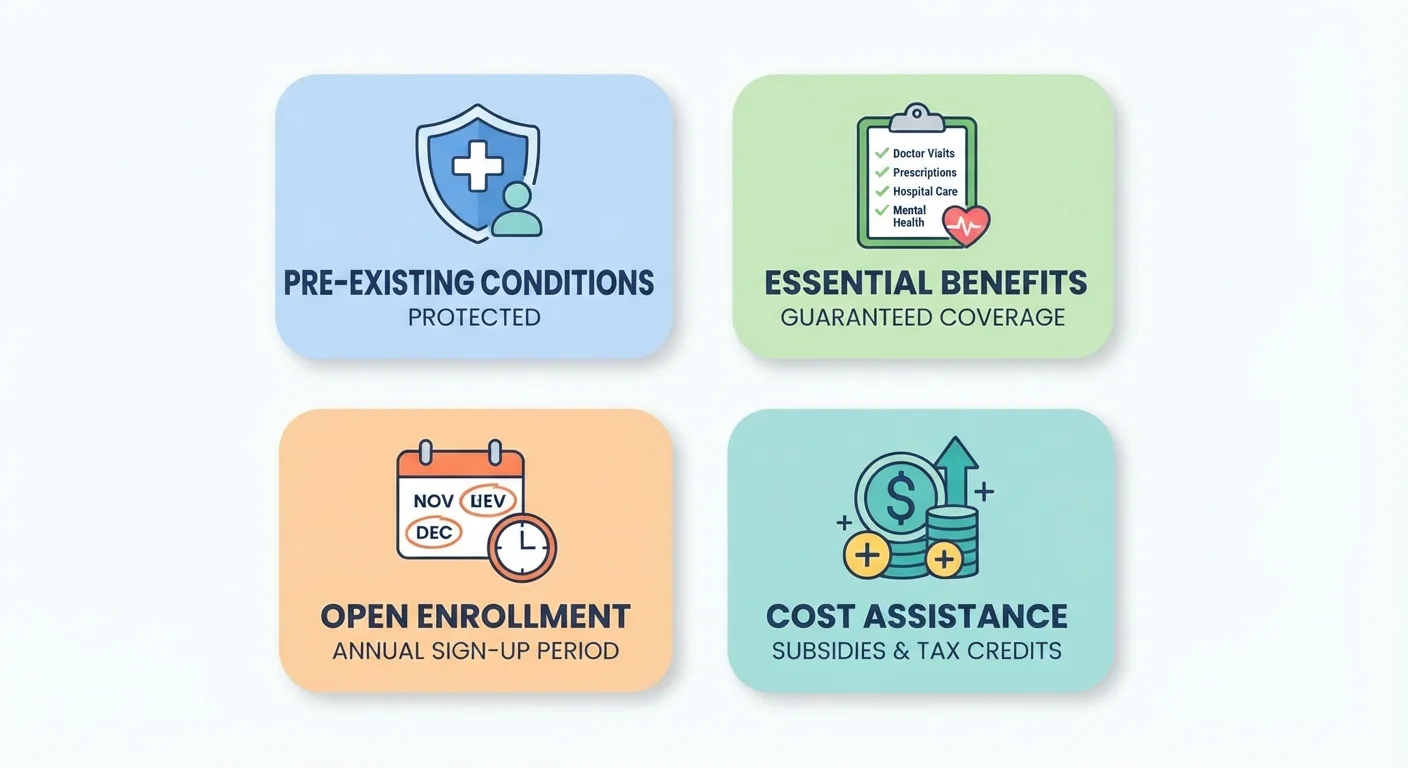
Pre-existing condition protections. Insurers in the individual and small-group markets cannot deny coverage, cancel a policy, or charge higher premiums because of a person's health history. This protection applies to all ACA-compliant plans, regardless of where you buy them.
Essential health benefits. Every ACA-compliant plan must cover ten categories of services: ambulatory (outpatient) care, emergency services, hospitalization, maternity and newborn care, mental health and substance use disorder services, prescription drugs, rehabilitative services, laboratory services, preventive and wellness services, and pediatric services including dental and vision for children. States set the specific benchmark for what counts within each category, so the exact services can vary.
No annual or lifetime limits on essential benefits. Plans cannot cap how much they will pay in a given year or over a lifetime for covered essential health benefits. This protection is particularly significant for people managing serious or chronic conditions.
Preventive care at no cost. ACA-compliant plans must cover a defined set of preventive services, such as recommended screenings and vaccines, without applying a deductible or copay. This applies when you see an in-network provider.
Dependent coverage to age 26. A parent's health plan must offer coverage to adult children up to age 26, regardless of whether the young adult is a student, married, or living away from home.
For a broader look at how these rules affect plan selection, see choosing a health plan during open enrollment.
Financial assistance through the marketplace
The ACA created health insurance marketplaces (also called exchanges) where individuals and families who do not have coverage through an employer or a government program can compare and purchase plans. Eligible buyers may qualify for premium tax credits, which reduce the monthly cost of coverage, or cost-sharing reductions, which lower deductibles and copays on certain plan tiers.
45M+
People with marketplace or Medicaid coverage gained under ACA
CMS reported that ACA-related coverage expansions, including Medicaid expansion and marketplace enrollment, have reached tens of millions of Americans since the law took effect.
10
Essential health benefit categories required by law
All ACA-compliant individual and small-group plans must cover these ten categories, as defined by federal law and state benchmark standards.
26
Maximum age for dependent coverage on a parent's plan
The ACA's dependent coverage provision allows young adults to remain on a parent's health plan through age 26, regardless of student or marital status.
Eligibility for financial assistance depends on household income, household size, and whether affordable employer-sponsored coverage is available. A licensed insurance navigator, broker, or agent can help you assess what you may qualify for based on your circumstances. This article is general information and is not a substitute for personalized advice from a qualified professional.
If you are new to buying coverage on your own, a starter guide for first-time health insurance buyers walks through the decisions involved.
What the ACA does not cover
The ACA's protections apply primarily to individual and small-group insurance markets. Large employer-sponsored plans must follow some ACA rules (such as the dependent coverage requirement and the ban on lifetime limits) but are governed differently in other respects. Short-term health plans and some other limited-benefit products are generally exempt from ACA requirements and may not include essential health benefits or pre-existing condition protections.
The law also does not guarantee that every service a person needs will be covered. Plans still have networks, formularies, prior authorization requirements, and cost-sharing structures that affect what a person actually pays. Reading a plan's summary of benefits and coverage document before enrolling gives a clearer picture of how costs will work for your situation.
Common misunderstandings about how coverage works, including ACA plans, are covered in common health insurance myths that cost people money.
This article is for general informational purposes only and does not constitute legal, financial, or medical advice. Coverage rules, eligibility requirements, and plan details vary. Consult a licensed insurance professional for guidance specific to your situation.
Frequently Asked Questions
Yes. The ACA's core protections remain federal law. Insurers selling individual and small-group plans must follow its rules, including the ban on pre-existing condition exclusions and the essential health benefits requirement.
Essential health benefits are ten categories of services that ACA-compliant plans must cover. They include emergency services, hospitalization, prescription drugs, maternity care, mental health services, and more. The exact services within each category can vary by state.
Eligibility for premium tax credits depends on household income and size. People who buy coverage through the federal or a state marketplace and meet income thresholds may qualify. A licensed insurance navigator or agent can help determine eligibility based on your situation.
No. Under ACA rules, insurers in the individual and small-group markets cannot charge higher premiums because of a person's health status or medical history. Premiums can only vary based on age, location, tobacco use, and plan tier.
Outside of open enrollment, you generally need a qualifying life event (such as losing other coverage or having a baby) to enroll in a marketplace plan. Some people may qualify for Medicaid or CHIP year-round, depending on income and state rules.
Standard ACA plans are not required to include adult dental or vision coverage. Pediatric dental and vision are listed as essential benefits for children, but adults typically need separate dental or vision plans for those services.
The content provided on our blog site traverses numerous categories, offering readers valuable and practical information. Readers can use the editorial team’s research and data to gain more insights into their topics of interest. However, they are requested not to treat the articles as conclusive. The website team cannot be held responsible for differences in data or inaccuracies found across other platforms. Please also note that the site might also miss out on various schemes and offers available that the readers may find more beneficial than the ones we cover.