


What makes an HSA different from other health accounts
Most people encounter health-related savings accounts through their employer, and the options can blur together. An HSA is distinct from a Flexible Spending Account (FSA) in two important ways: the balance carries forward every year, and the account belongs to you permanently. If you leave your job, the HSA goes with you.
An FSA, by contrast, is typically use-it-or-lose-it within the plan year, and it does not require enrollment in an HDHP. A Health Reimbursement Arrangement (HRA) is funded entirely by the employer, not the employee. Understanding those differences helps when comparing plan options during open enrollment. See our plain-English glossary of health insurance terms for definitions of these and related concepts.
Who can open and contribute to an HSA
To contribute to an HSA in any given month, you must be enrolled in an IRS-qualifying HDHP, have no other disqualifying health coverage, and not be enrolled in Medicare. You also cannot be claimed as a dependent on someone else's tax return.
The IRS updates the minimum deductible and out-of-pocket maximum thresholds that a plan must meet to qualify as an HDHP each year. For 2025, a qualifying plan must have a minimum deductible of $1,650 for self-only coverage or $3,300 for family coverage. Confirming that your specific plan qualifies before opening an account is worth doing, since not every high-deductible plan automatically meets the IRS definition. A closer look at HDHP trade-offs can help you assess whether that plan structure fits your situation.
Check your plan's HSA eligibility before contributing
Not every plan marketed as 'high-deductible' meets the IRS definition for HSA eligibility. Review your Summary of Benefits and Coverage or contact your plan administrator to confirm your plan qualifies before making contributions. Contributing to an HSA while enrolled in a non-qualifying plan can result in tax penalties.
How contributions and withdrawals work
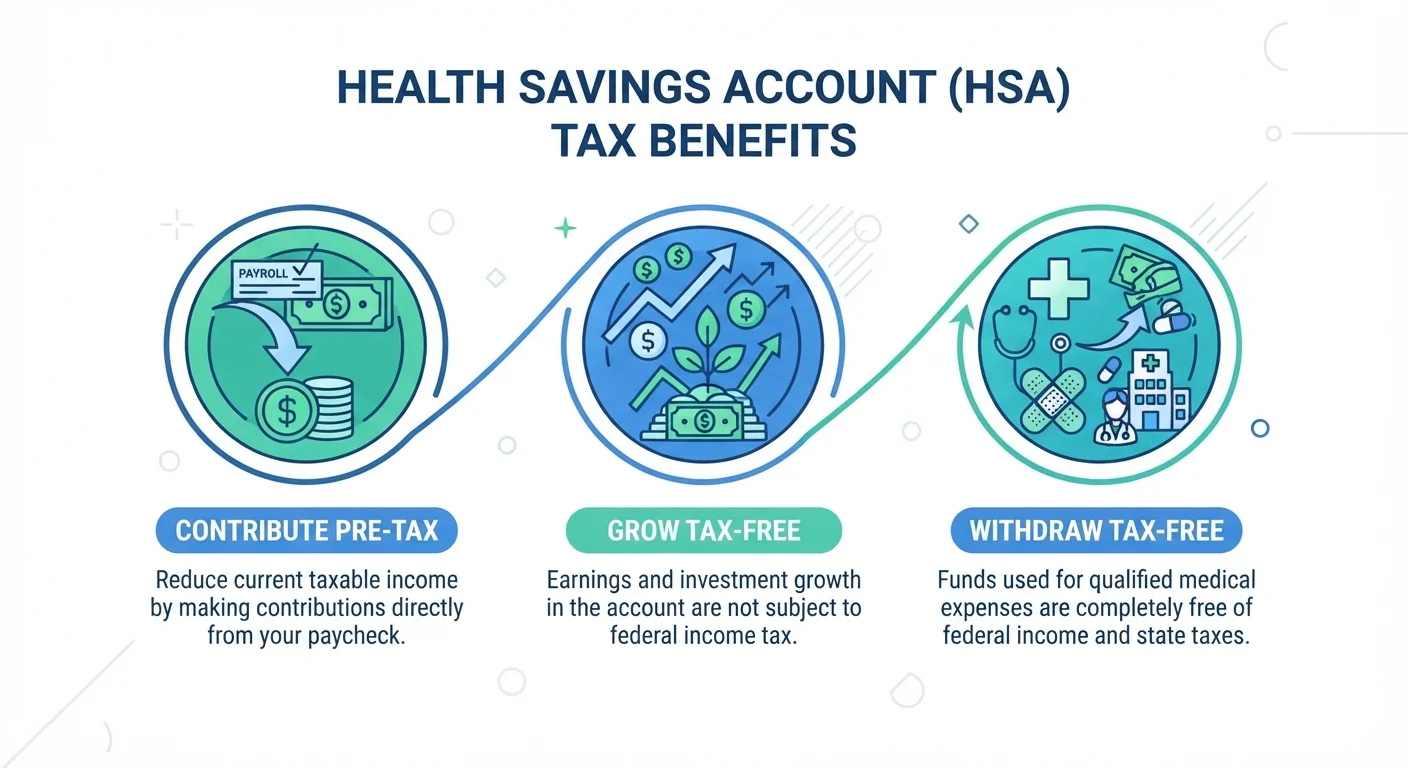
Contributions can come from you, your employer, or both, as long as the combined total stays within the annual IRS limit. Employer contributions count toward that cap. If you contribute through payroll deduction, the money is excluded from your gross income before federal (and usually state) income taxes are calculated. Contributions made directly to the account are deductible on your federal tax return even if you do not itemize deductions.
Withdrawals for qualified medical expenses are tax-free at any age. The IRS defines qualified expenses broadly to include deductibles, copayments, coinsurance, dental care, vision care, and many prescription and over-the-counter items. Cosmetic procedures and most insurance premiums do not qualify, with specific exceptions such as COBRA premiums and Medicare premiums after age 65.
$4,300
2025 HSA contribution limit, self-only coverage
Per IRS Revenue Procedure 2024-25, applicable to tax year 2025.
$8,550
2025 HSA contribution limit, family coverage
Per IRS Revenue Procedure 2024-25, applicable to tax year 2025.
$1,000
Catch-up contribution allowed at age 55 and older
This additional amount is available each year to HSA-eligible individuals who are 55 or older and not yet enrolled in Medicare.
HSAs and long-term planning
Because funds roll over indefinitely, some people use an HSA as a secondary retirement savings vehicle. The idea is to pay current medical costs out of pocket during working years and let the HSA balance grow tax-free, then use those accumulated funds for healthcare costs in retirement, when medical expenses are often higher. This approach requires having enough cash flow to cover current medical bills without tapping the account.
After age 65, HSA funds can pay Medicare premiums for Parts B, C, and D, which is an expense that most other pre-tax accounts cannot cover. This makes the HSA unusually flexible for retirement health planning. Anyone weighing this strategy should consult a licensed financial adviser, since individual circumstances vary considerably. If you are still deciding on a health plan structure, comparing options during open enrollment is a useful starting point.
This article provides general information about Health Savings Accounts and is not financial, tax, or medical advice. Contribution limits, eligibility rules, and qualified expense definitions are set by the IRS and may change annually. Consult a licensed financial adviser or tax professional for guidance specific to your situation.
Frequently Asked Questions
Yes, but the tax treatment changes. Before age 65, non-medical withdrawals are subject to ordinary income tax plus a 20% penalty. After age 65, the penalty disappears, so the funds work similarly to a traditional IRA withdrawal, taxed as ordinary income.
No. Unlike a Flexible Spending Account (FSA), HSA balances roll over indefinitely. There is no use-it-or-lose-it rule, and the account stays with you even if you change jobs or health plans.
Generally, you cannot contribute to both a standard FSA and an HSA simultaneously. However, a Limited-Purpose FSA, which covers only dental and vision costs, is compatible with an HSA. Confirm the specific rules with your plan administrator.
Once you enroll in any part of Medicare, you can no longer make new contributions to your HSA. You may continue to use existing HSA funds to pay for eligible medical expenses, including Medicare premiums for Parts B, C, and D.
Many HSA administrators allow account holders to invest their balance in mutual funds or other instruments once it reaches a set threshold. Investment earnings grow tax-free as long as funds are used for eligible medical expenses.
The content provided on our blog site traverses numerous categories, offering readers valuable and practical information. Readers can use the editorial team’s research and data to gain more insights into their topics of interest. However, they are requested not to treat the articles as conclusive. The website team cannot be held responsible for differences in data or inaccuracies found across other platforms. Please also note that the site might also miss out on various schemes and offers available that the readers may find more beneficial than the ones we cover.