

Our Verdict
An HDHP can work well when your medical needs are predictable and infrequent, and when you have the savings to cover a high deductible if something unexpected happens. For people managing ongoing health conditions or those without a financial cushion, the lower premium may be outweighed by higher costs at the point of care.
Generally suits healthy adults with low expected medical utilization who want to use an HSA to build tax-advantaged savings for future health expenses.
What makes a health plan 'high-deductible'
A high-deductible health plan (HDHP) is a specific plan category defined by the IRS, not just any plan with a large deductible. To qualify, a plan must meet minimum deductible thresholds and stay within set out-of-pocket maximums. For 2025, the IRS requires a minimum deductible of $1,650 for self-only coverage and $3,300 for family coverage.
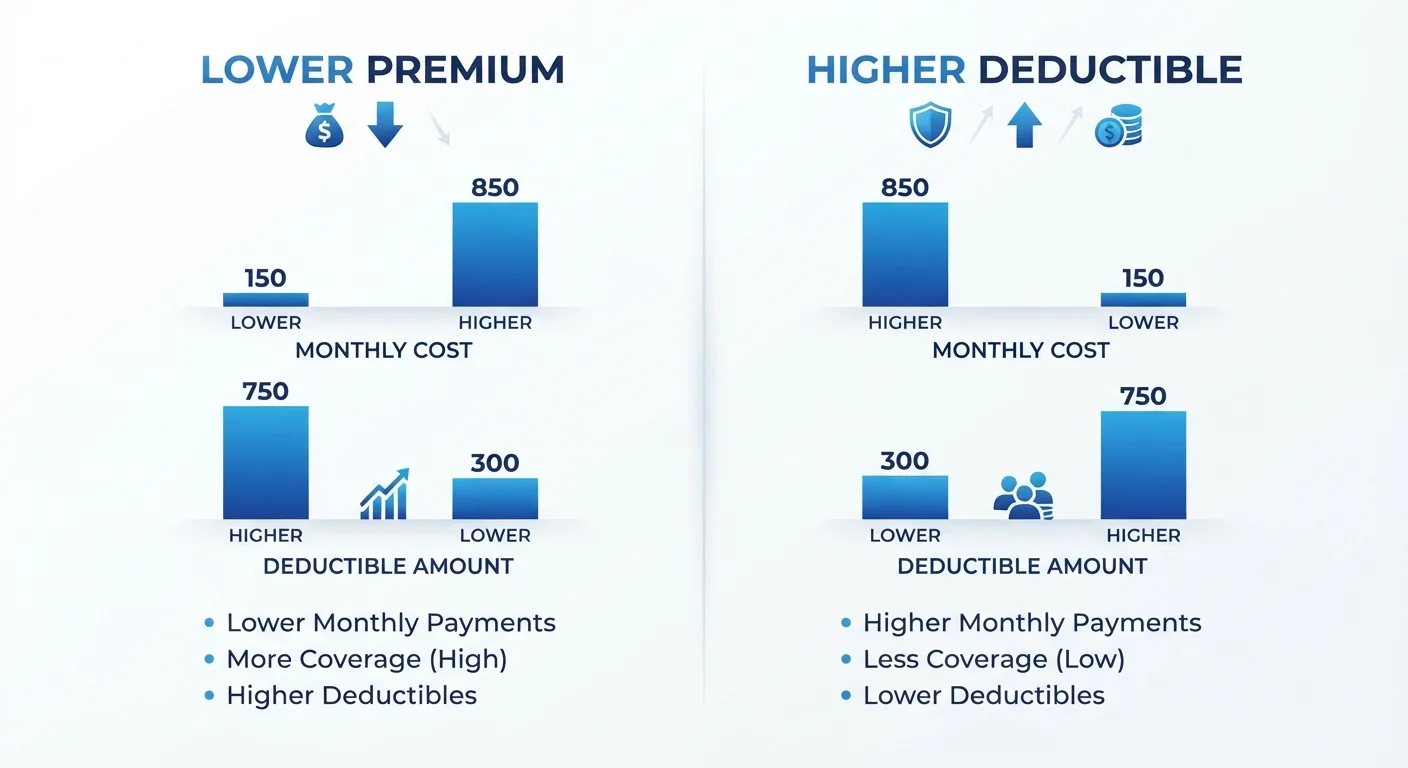
That structure separates HDHPs from conventional plans. Under a traditional preferred provider organization (PPO) or health maintenance organization (HMO), cost-sharing is spread more evenly through copays and coinsurance from the first visit. Under an HDHP, most costs sit with the enrollee until the deductible is met, after which the insurer begins sharing costs. The trade-off is a lower monthly premium in exchange for that higher initial exposure.
For a plain-English explanation of terms like deductible, coinsurance, and out-of-pocket maximum, see our health insurance terms glossary.
Where HDHPs work in your favor
The financial case for an HDHP is clearest when annual medical spending stays low. If you end a year without meeting your deductible, you paid less in premiums and kept the difference. That math changes if you use care frequently, but for healthy adults with limited medical needs, it can favor an HDHP on a total-cost basis.
Lower monthly premiums reduce regular expenses
HDHPs typically carry premiums well below those of traditional plans with lower deductibles. For someone who rarely uses medical services, the monthly savings can add up considerably over a plan year.
HSA eligibility creates a tax-advantaged savings option
Enrolling in a qualifying HDHP is the only way to open a Health Savings Account. Contributions are tax-deductible, growth is tax-free, and withdrawals for qualified medical expenses are not taxed, making an HSA a triple tax benefit.
Unused HSA funds roll over indefinitely
Unlike a Flexible Spending Account, an HSA balance carries over from year to year. This lets account holders build a reserve for future medical costs, including expenses in retirement.
Out-of-pocket maximum caps total exposure
Federal rules require HDHPs to have a defined out-of-pocket maximum. Once you reach that limit in a plan year, the insurer pays 100% of covered in-network costs, which limits catastrophic financial risk.
Preventive care is covered before the deductible
Under the Affordable Care Act, most HDHPs must cover a defined set of preventive services at no cost to the enrollee, even before the deductible is met. This includes screenings, immunizations, and annual wellness visits.
The HSA connection is often the most consequential advantage. Funds contributed to an HSA are not subject to federal income tax going in, while invested they grow tax-free, and withdrawals for qualified medical expenses are also tax-free. Unused balances roll over indefinitely, so the account can function as a long-term medical savings reserve. Our article on how Health Savings Accounts work covers contribution limits and eligible expenses in detail.
Where HDHPs create real risk
The same structure that lowers premiums also shifts financial exposure directly to the enrollee. Before the deductible is met, most covered services are paid out of pocket at the plan's negotiated rate. For someone managing a chronic condition, that means predictable, recurring costs every year.
High upfront costs can delay or deter needed care
When a deductible runs into thousands of dollars, some people avoid doctor visits or postpone filling prescriptions to manage costs. Research published by health policy organizations has found that high cost-sharing can reduce both necessary and unnecessary care.
People with chronic conditions often pay more overall
Anyone who regularly uses specialist visits, ongoing prescriptions, or physical therapy is likely to meet or exceed their deductible most years. In that scenario, the lower premium rarely compensates for the higher cost-sharing.
Requires financial reserves to be practical
An HDHP only works as intended if you can actually cover the deductible. Without savings set aside, a single hospitalization or unexpected diagnosis can create significant financial strain.
HSA benefit is limited if you cannot contribute
The tax advantages of an HSA require you to fund the account. People with tight budgets may not be able to contribute enough to offset the higher cost-sharing, which reduces one of the plan's main advantages.
Plan complexity can lead to billing surprises
Because cost-sharing under an HDHP is front-loaded, enrollees need to understand which services apply to the deductible, which are covered pre-deductible, and how in-network versus out-of-network rules interact. Misunderstanding these details can result in unexpected bills.
There is also a behavioral dimension. When every visit has a direct cost attached, some people delay care. That choice can be rational for minor issues, but it becomes a health risk when it involves symptoms that warrant prompt attention. This article is for general informational purposes and does not constitute medical advice. Decisions about whether to seek care should always involve a qualified healthcare provider.
HDHPs and Medicare do not mix
Once you enroll in any part of Medicare, you are no longer eligible to contribute to an HSA, even if you remain on an HDHP through a spouse's employer plan. If you plan to delay Medicare and stay on an employer HDHP, confirm the rules with your benefits administrator and a licensed insurance counselor before making decisions.
How to evaluate whether an HDHP fits your situation
Comparing plans on premium alone misses most of the picture. A more complete method is to estimate total annual cost under each option: add the yearly premium to your expected out-of-pocket spending based on your actual health history. Then compare that figure across plan types.
Consider whether you have, or can build, savings to cover the deductible. An HDHP without an emergency fund behind it is a financial risk if an unplanned health event occurs. Also consider whether contributing to an HSA is realistic given your budget, since the account's tax advantages require active funding to be useful.
If you are approaching age 65 or managing a serious condition, the calculus often shifts toward plans with lower cost-sharing at the point of care. The open enrollment comparison guide walks through how to weigh these factors side by side. Preventive services are one area where HDHPs and traditional plans overlap: most plans cover a defined set of screenings and vaccines at no cost, which is worth factoring in. For more on that, see our piece on using preventive care benefits.
This article is for informational purposes only and is not a substitute for personalized advice from a licensed insurance professional or qualified healthcare provider. Coverage terms, costs, and eligibility rules vary by plan and by state. Always review your plan documents and consult a licensed insurance counselor before making enrollment decisions.
The content provided on our blog site traverses numerous categories, offering readers valuable and practical information. Readers can use the editorial team’s research and data to gain more insights into their topics of interest. However, they are requested not to treat the articles as conclusive. The website team cannot be held responsible for differences in data or inaccuracies found across other platforms. Please also note that the site might also miss out on various schemes and offers available that the readers may find more beneficial than the ones we cover.