


Option A
Medicare
Federal health insurance tied to age and work history.
Best for: Adults 65 and older, and certain younger people with qualifying disabilities or end-stage renal disease.
Option B
Medicaid
Joint federal-state health coverage based on income and need.
Best for: Low-income adults, children, pregnant people, and individuals with disabilities who meet their state's financial eligibility rules.
Who each program covers
Medicare and Medicaid share a name prefix, but they serve different populations and operate under different rules.
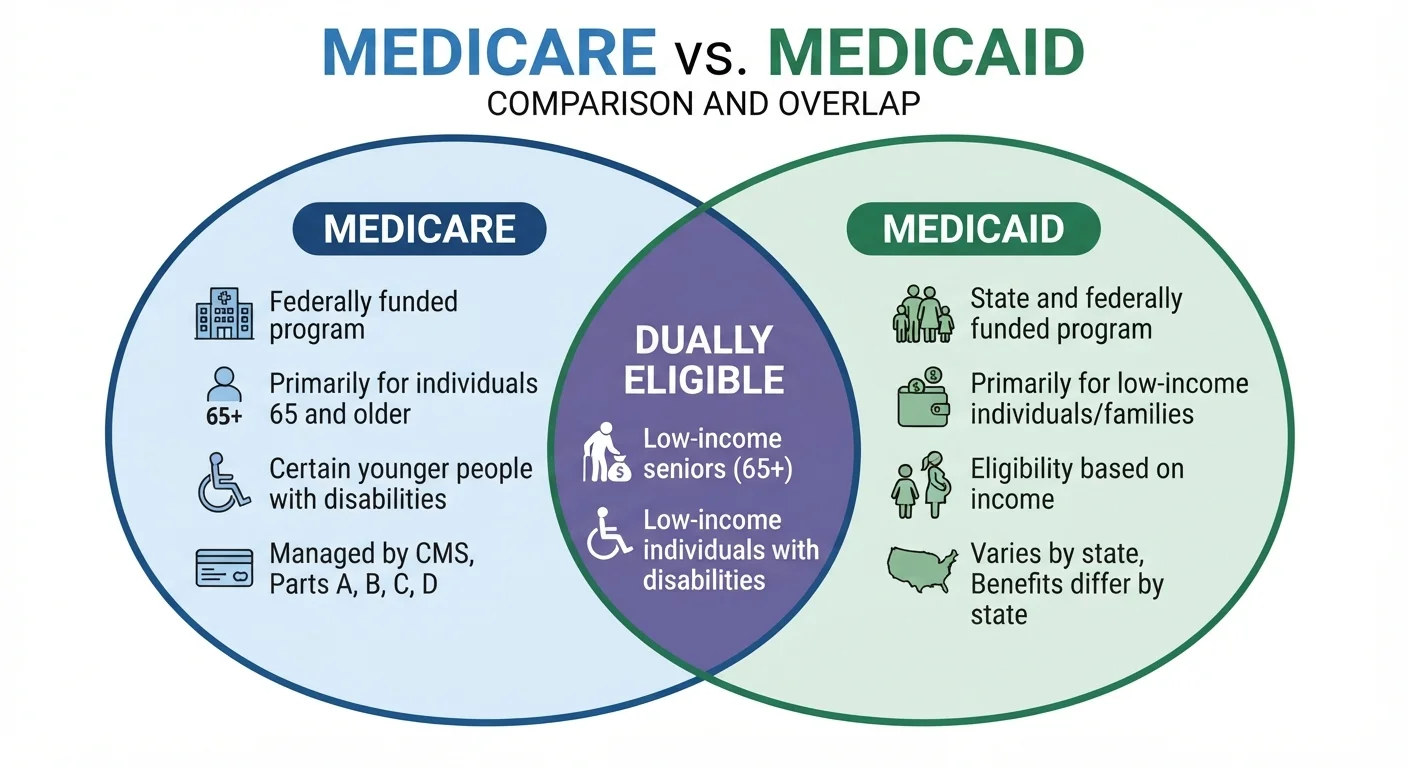
Medicare is a federal program administered by the Centers for Medicare and Medicaid Services (CMS). Eligibility is based primarily on age: U.S. citizens and permanent residents who are 65 or older and have at least 10 years of Medicare-covered work history can enroll. Younger people may also qualify if they have received Social Security Disability Insurance (SSDI) for 24 months, or if they have amyotrophic lateral sclerosis (ALS) or end-stage renal disease (ESRD).
Medicaid is a joint federal-state program. The federal government sets baseline requirements, but each state designs and administers its own version, which means income thresholds, covered services, and enrollment processes differ by state. Under the Affordable Care Act, states that expanded Medicaid generally cover adults up to 138 percent of the federal poverty level. Non-expansion states apply narrower rules. Medicaid also covers children through the Children's Health Insurance Program (CHIP) in most states.
For a closer look at how Medicare is structured internally, see how Medicare Parts A, B, C, and D work.
How costs compare
Cost structure is one of the clearest differences between the two programs.
Medicare uses a premium-plus-cost-sharing model. Most people pay no premium for Part A (hospital insurance) if they have sufficient work history, but Part B (medical insurance) carries a standard monthly premium set annually by CMS. Enrollees also face deductibles and coinsurance for most services. People who want to limit out-of-pocket exposure often purchase a Medicare Supplement (Medigap) policy. What to look for in a Medigap plan covers the factors worth reviewing before enrolling.
Medicaid, by contrast, typically charges little or nothing at the point of care. Federal rules cap cost-sharing for most Medicaid enrollees at nominal amounts, and many states charge no premiums at all. This makes Medicaid substantially more affordable on a month-to-month basis for people who qualify.
| Criterion | Medicare | Medicaid |
|---|---|---|
| Primary eligibility basis | Age 65+, or qualifying disability | Income and household size |
| Administered by | Federal government (CMS) | Federal and state governments jointly |
| Monthly premiums | Part B premium required; Part A usually free | Often none; varies by state |
| Cost-sharing | Deductibles and coinsurance apply | Nominal or none for most enrollees |
| Long-term care coverage | Limited; short-term skilled nursing only | Yes, including nursing home and home care |
| Prescription drug coverage | Part D (separate enrollment) | Included in most state plans |
| Dental and vision | Not generally covered | Varies by state; often included |
What each program covers and where the gaps are
Medicare covers inpatient hospital care (Part A), outpatient and physician services (Part B), and prescription drugs (Part D). Medicare Advantage (Part C) bundles these through private insurers and may include some additional benefits. However, Medicare does not generally cover routine dental, vision, or hearing care, and its long-term care coverage is limited to short-term skilled nursing stays following a qualifying hospital admission.
Medicaid covers a broader set of services in many states, including long-term care in nursing facilities and home- and community-based settings. This is a meaningful difference for older adults who need ongoing personal care. Medicaid's long-term care coverage and eligibility rules explains the income and asset considerations in more detail.
People who rely solely on Medicare sometimes face surprise costs in areas they assumed were covered. Common misconceptions about Medicare coverage addresses several of the most frequent misunderstandings.
State variation matters for Medicaid
Because Medicaid is state-administered, the services covered, income limits, and enrollment rules in your state may differ substantially from general descriptions. Contact your state Medicaid agency or call 1-800-MEDICARE for referrals to local assistance programs. Do not rely on general summaries alone when making coverage decisions.
Dual eligibility: when both programs apply
Some people qualify for Medicare and Medicaid at the same time. CMS refers to them as dual eligible beneficiaries. In this situation, Medicare generally pays first and Medicaid covers some or all of the remaining costs, including premiums, deductibles, and coinsurance. Medicaid may also pay for services Medicare excludes, such as long-term personal care.
Dual eligibility is more common among low-income older adults and people with disabilities who have limited income and assets despite qualifying for Medicare through age or disability status. Enrollment in both programs is not automatic; a person must apply to their state Medicaid agency separately.
Medicare and Medicaid operate alongside other federal benefit programs. If you are also sorting out Social Security income questions, the difference between SSI and Social Security retirement may be useful context.
This article is for general informational purposes only and is not medical, legal, or financial advice. Eligibility rules and covered services change periodically and vary by state. Consult a licensed insurance counselor, your State Health Insurance Assistance Program (SHIP), or a qualified professional for guidance specific to your situation.
The content provided on our blog site traverses numerous categories, offering readers valuable and practical information. Readers can use the editorial team’s research and data to gain more insights into their topics of interest. However, they are requested not to treat the articles as conclusive. The website team cannot be held responsible for differences in data or inaccuracies found across other platforms. Please also note that the site might also miss out on various schemes and offers available that the readers may find more beneficial than the ones we cover.